
Written by Ansu Susan Kuriakose, BPT · Clinically reviewed by Jasmal K, BPT, MPT · Last reviewed 5 October 2026
Ankylosing spondylitis: exercise and physiotherapy alongside medical care
Ankylosing spondylitis (AS) is a long-term inflammatory condition that mainly affects the spine and the sacroiliac joints where the spine meets the pelvis. It's part of a group of conditions called axial spondyloarthritis. It's diagnosed and treated by a doctor, usually a rheumatologist. Regular exercise and physiotherapy are recommended alongside that medical care.
At Maana Spine, treatment is adapted for AS and varies with how active and severe your condition is.
Book a Spine Assessment · or call or WhatsApp +91 99950 09403

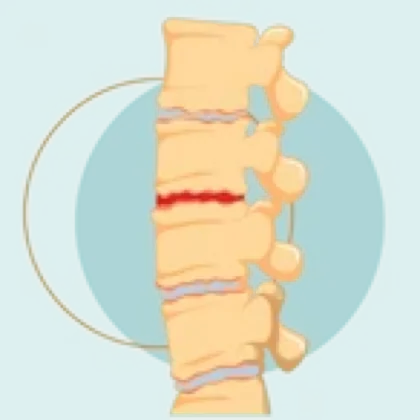
What is ankylosing spondylitis?
In AS, inflammation affects the joints of the spine and pelvis, and the places where ligaments and tendons attach to bone. Over time, in some people, parts of the spine can stiffen. Treatment aims to control inflammation, ease pain and stiffness, and keep you moving.
AS can also affect other parts of the body, such as the eyes, gut and skin.
Signs of inflammatory back pain
Back pain from AS often looks different from ordinary back pain:
- it has lasted months rather than weeks, and often started before age 45
- it's worse with rest and in the morning, with stiffness that can last a long time
- it eases with movement and exercise
- it may wake you in the second half of the night
- there may be pain in the buttocks, which can alternate between sides
If this sounds familiar and you haven't been diagnosed, see a doctor. A rheumatologist can confirm the diagnosis with an examination, blood tests and scans.
When to get help urgently
How it's assessed
At your Maana Spine assessment, your physiotherapist asks about your diagnosis, symptoms and medicines, checks your posture, spinal movement, breathing and strength, and reviews any reports you bring. If your symptoms suggest AS and you haven't been diagnosed, we'll advise you to see a doctor.
You'll get a physiotherapy diagnosis and a personalised plan. You don't need a scan to book; if one would help, your physiotherapist will recommend an MRI or X-ray.
How we approach AS at Maana Spine
Treatment follows a special adaptation of Maana Spine DTX™, alongside your rheumatologist's care. PST, exercise and pain management (short-term pain relief, such as cold therapy and electrotherapy) are the main treatments:
 Assess: we look at your symptoms, spinal movement, posture and how active your condition is.
 Decompress and PST: pulsed signal therapy (PST), a CE-marked treatment, is one of the main treatments. Spinal decompression is typically used only in early-stage cases, where appropriate. If you have significant inflammation, hyperbaric oxygen therapy (HBOT) may be considered as an option, alongside your medical care. HBOT is available at our Kochi, Kozhikode and Thiruvananthapuram clinics.
 Restore: pain management, mobility work, hands-on (manual) therapy where appropriate, and physiotherapist-led stretching to maintain movement.
 Strengthen: our four-level exercise roadmap (Level 1 Restore, Level 2 Stabilise, Level 3 Strengthen, Level 4 Maintain), adapted for AS, with mobility, strengthening, posture and breathing exercises.
 Empower: how to keep moving every day, with written and app-based home exercise programmes, with written and app-based home exercise programmes.
 Maintain: in-person follow-up at 1, 3, 6 and 12 months. The 1- and 3-month follow-ups are included in your program fee; the 6- and 12-month reviews are charged separately.
A DTX program is typically 15 to 25 sessions of 60 to 75 minutes each. Your physiotherapist will tell you after your assessment how many you're likely to need.
What the research and guidelines say
The 2022 international ASAS-EULAR recommendations for axial spondyloarthritis say people with the condition should:
- be educated about it
- exercise regularly
- stop smoking
- consider physiotherapy
Anti-inflammatory medicines (NSAIDs) are the first-choice drug treatment, prescribed by a doctor. Other medicines may be added by your rheumatologist.
The review behind these recommendations found that exercise had moderate to large benefits for disease activity, function and spinal mobility.
Physiotherapy works alongside medical treatment, not instead of it.
PST. PST is a type of pulsed electromagnetic field (PEMF) therapy. Reviews found PEMF reduced long-lasting low back pain, but we haven't found trials of PEMF specifically in ankylosing spondylitis. Read our review of the PST evidence
HBOT. A 2025 review of hyperbaric oxygen therapy in muscle and joint pain conditions found it may help as an add-on treatment, but the evidence is limited. We haven't found trials of HBOT in ankylosing spondylitis, and it isn't part of the international recommendations.
Practical tips
- Move every day. Regular exercise is one of the most important things you can do.
- Start the day with gentle movement to ease morning stiffness.
- Stop smoking if you smoke.
- Keep your medical appointments and take medicines as your doctor advises.
These are general tips, not a substitute for an assessment.
When to book a spine assessment
Book an assessment if you've been diagnosed with AS or axial spondyloarthritis and want a structured exercise and physiotherapy plan. If you have signs of inflammatory back pain but no diagnosis, see a doctor too. Spine assessments are available at all five Maana Spine clinics in Kochi, Kozhikode, Thiruvananthapuram, Aluva and Perinthalmanna. The consultation fee is ₹250, and no doctor's referral is needed.
Book a Spine Assessment · or call or WhatsApp +91 99950 09403
Frequently asked questions
Can physiotherapy help ankylosing spondylitis?
Yes, as part of your overall care. International recommendations say people with axial spondyloarthritis should exercise regularly and consider physiotherapy, alongside medical treatment from a rheumatologist.
What exercises are good for ankylosing spondylitis?
Mobility, stretching, strengthening, posture and breathing exercises help many people. Your physiotherapist will tailor them to you.
Can physiotherapy replace my medicines?
No. Physiotherapy works alongside your medical treatment. Don't stop or change any medicine without talking to your doctor.
How do I know if my back pain is inflammatory?
Inflammatory back pain usually lasts months, often starts before 45, is worse in the morning and with rest, and eases with movement. If this sounds like you, see a doctor.
Is spinal decompression used for AS?
Typically only in early-stage cases, where appropriate. PST, exercise and pain management are the main treatments for AS at Maana Spine. Your physiotherapist decides at your assessment.
Will exercise make AS worse?
Regular exercise is recommended for AS. Your physiotherapist will adjust your programme to your symptoms and flare-ups.
References
- Ramiro S, Nikiphorou E, et al. ASAS-EULAR recommendations for the management of axial spondyloarthritis: 2022 update. Annals of the Rheumatic Diseases, 2023;82(1):19–34. doi.org/10.1136/ard-2022-223296
- Ortolan A, et al. Efficacy and safety of non-pharmacological and non-biological interventions: a systematic literature review informing the 2022 update of the ASAS/EULAR recommendations for the management of axial spondyloarthritis. Annals of the Rheumatic Diseases, 2023;82(1):142–152. doi.org/10.1136/ard-2022-223297
- Sun X, Huang L, Wang L, et al. Clinical Rehabilitation, 2022;36(5):636–649. pubmed.ncbi.nlm.nih.gov/35077249
- Effectiveness of hyperbaric oxygen therapy for musculoskeletal pain syndromes: a systematic review. Muscles, 2025;4(4):63. pubmed.ncbi.nlm.nih.gov/41441449