
Written by Ansu Susan Kuriakose, BPT · Clinically reviewed by Jasmal K, BPT, MPT · Last reviewed 5 October 2026
Upper back pain: causes, warning signs and treatment
Pain in your upper or middle back, often between the shoulder blades, is common, especially if you spend long hours at a desk, on a phone or on a two-wheeler. Most of it comes from muscles and joints and responds well to the right exercise and care. Because upper back pain is a little more likely than lower back pain to have a medical cause, it's also worth knowing the warning signs.
Book a Spine Assessment · or call or WhatsApp +91 99950 09403
What is upper back pain?
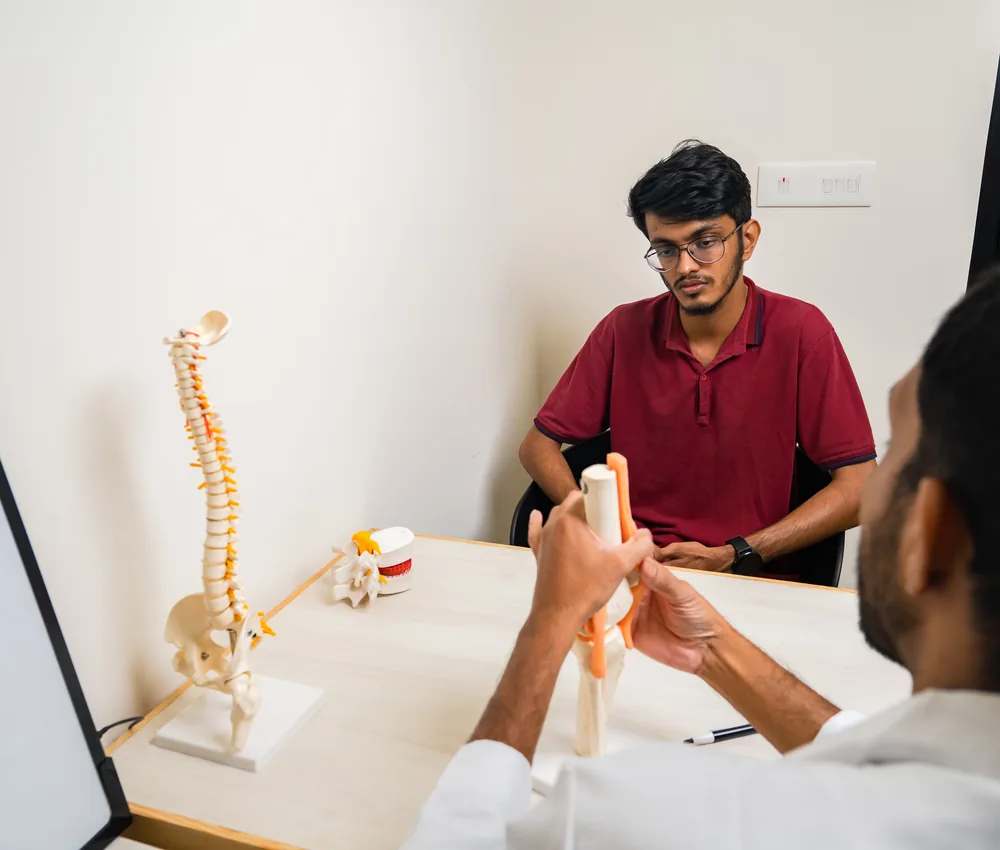
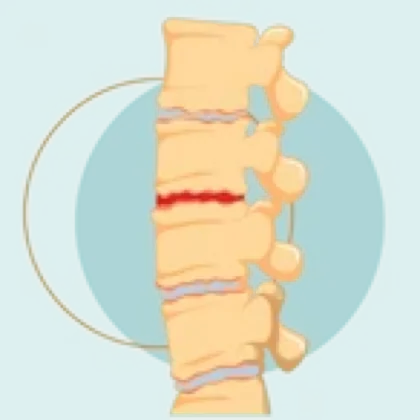
Your upper and middle back is called the thoracic spine: the 12 vertebrae between your neck and lower back, which connect to your ribs. Upper back pain is common, but it has received far less research attention than neck and lower back pain.
Common causes
- Muscle strain or tension, including tight, tender spots (trigger points) in the muscles between and around the shoulder blades
- Stiff joints where the ribs meet the spine
- Long hours in one position, such as at a desk, on a phone or riding
- Neck problems that refer pain into the upper back (neck pain)
- Age-related changes in the thoracic spine
- Injury, such as a fall or road accident
Symptoms
- aching, burning or sharp pain between or around the shoulder blades
- stiffness when twisting, or taking a deep breath
- tight, tender spots in the muscles
- pain that's worse after long periods sitting or looking down
When upper back pain needs urgent help
How it's diagnosed
At your Maana Spine assessment, your physiotherapist asks about your symptoms, work and daily routine, screens carefully for warning signs, checks how your upper back, neck, ribs and shoulders move, and reviews any MRI, X-ray or lab reports you bring. Scan changes in the upper back aren't necessarily linked to pain, so how you move and feel matters most.
You'll get a physiotherapy diagnosis and a personalised plan. You don't need a scan to book; if one would help, your physiotherapist will recommend an MRI or X-ray.
How we treat upper back pain at Maana Spine
Treatment follows Maana Spine DTX™, our personalised, non-surgical Precision Spine Care program:
 Assess: we find out what's causing your pain and rule out warning signs.
 Decompress: usually not needed for muscle and joint pain in the upper back. Where a disc problem in the neck is also involved, decompression with cervical positioning may be used if it suits your condition.
 Restore: mobility work for the upper back and ribs, physiotherapist-led stretching, and shockwave therapy (ESWT) for tight, tender trigger points where needed.
 Strengthen: our four-level exercise roadmap (Level 1 Restore, Level 2 Stabilise, Level 3 Strengthen, Level 4 Maintain) for the upper back, shoulder-blade and neck muscles.
 Empower: practical changes for work, screens, riding and sleep, with written and app-based home exercise programmes.
 Maintain: in-person follow-up at 1, 3, 6 and 12 months. The 1- and 3-month follow-ups are included in your program fee; the 6- and 12-month reviews are charged separately.
A DTX program is typically 15 to 25 sessions of 60 to 75 minutes each. Your physiotherapist will tell you after your assessment how many you're likely to need.
What the research says
Upper back pain has had much less research than neck or lower back pain, so there's little evidence specific to it. Two findings are useful:
- Shockwave therapy (ESWT) for trigger points. Reviews show shockwave therapy (ESWT) reduces pain from neck and upper-back (trapezius) trigger points more than sham treatment. Evidence that it beats other active treatments, such as dry needling, is weaker.
- Exercise and hands-on care. The 2017 neck pain guideline from the American Physical Therapy Association recommends exercise and hands-on therapy, including treatment to the upper back, for many types of neck pain, which often overlaps with upper back pain.
Practical tips
- Move often. Change position and roll your shoulders regularly, especially at a desk or on your phone.
- Breathe and twist gently. Easy rotation and deep-breathing movements can ease stiffness.
- Set up your screen so you're not looking down for long periods.
- Stay active. Regular exercise helps your upper back cope with long days.
These are general tips, not a substitute for an assessment.
When to book a spine assessment
Book an assessment if upper back pain has lasted more than a couple of weeks, keeps coming back, or affects your work or sleep, and you don't have any of the warning signs above. Spine assessments are available at all five Maana Spine clinics in Kochi, Kozhikode, Thiruvananthapuram, Aluva and Perinthalmanna. The consultation fee is ₹250, and no doctor's referral is needed.
Book a Spine Assessment · or call or WhatsApp +91 99950 09403
Frequently asked questions
When should I worry about upper back pain?
Call 112 if it comes with chest pain, breathlessness, sweating, nausea or pain spreading to your arm or jaw, or if it's sudden, severe and tearing. See a doctor promptly after a fall, or if you have fever, unexplained weight loss, a history of cancer or night pain.
What causes pain between the shoulder blades?
Most often, muscle tension, stiff joints or long hours in one position. Neck problems can also refer pain there. Less commonly, it comes from the heart, lungs or other organs, which is why warning signs matter.
Can stress cause upper back pain?
Stress can make muscles tense and pain feel worse. It's one of several factors your physiotherapist will consider.
Is upper back pain related to posture?
Long periods in one position can contribute. Moving regularly and building strength usually matter more than holding a "perfect" posture.
What exercises help upper back pain?
Gentle mobility, rotation and strengthening exercises for the upper back and shoulder-blade muscles help many people. Your physiotherapist will tailor them to you.
How many sessions will I need?
A Maana Spine DTX™ program is typically 15 to 25 sessions of 60 to 75 minutes each. Your physiotherapist will suggest a plan after your assessment.
References
- Briggs AM, Smith AJ, Straker LM, Bragge P. Thoracic spine pain in the general population: prevalence, incidence and associated factors in children, adolescents and adults. A systematic review. BMC Musculoskeletal Disorders, 2009;10:77. doi.org/10.1186/1471-2474-10-77
- Patient.info. Thoracic back pain. patient.info
- Patient.info. Low back pain and sciatica. patient.info
- Wu et al. Annals of Translational Medicine, 2022. atm.amegroups.org
- Blanpied PR, Gross AR, Elliott JM, et al. Neck Pain: Revision 2017. Journal of Orthopaedic & Sports Physical Therapy, 2017;47(7):A1–A83. doi.org/10.2519/jospt.2017.0302