
Written by Ansu Susan Kuriakose, BPT · Clinically reviewed by Jasmal K, BPT, MPT · Last reviewed 5 October 2026
Disc bulge (bulging disc): what it means and how it's treated without surgery
If your MRI report says "disc bulge," it can sound alarming. It doesn't have to be. Disc bulges are very common, including in people with no back pain at all, and many people with a bulge-related "disc complaint" improve with the right non-surgical care.
What matters is whether the bulge is actually causing your symptoms, and if it is, treating the cause.
Book a Spine Assessment · or call or WhatsApp +91 99950 09403

What is a disc bulge?
Between each of the bones (vertebrae) in your spine is a disc: a tough outer ring with a softer, gel-like centre. Discs act as shock absorbers and let your spine bend and twist.
A disc bulge means the disc extends beyond its normal edge, usually evenly around a wide part of its rim, a bit like a cushion squashed under weight. The outer ring stays intact.
Disc bulge or slipped disc? People often use these words for the same thing, but they're different:
- In a bulge, the disc spreads out more broadly, and the outer ring is intact.
- In a slipped (herniated) disc, some of the soft centre pushes out through a weak point in the outer ring.
Both can press on a nerve, and both are treated in similar ways.
Read about slipped (herniated) discs
Bulges are most common in the lower back, especially at the L4-L5 and L5-S1 levels, which carry the most load. They can also happen in the neck.
Symptoms of a disc bulge
A disc bulge often causes no symptoms at all. When it does, you may notice:
- aching or stiffness in your lower back
- pain that's worse when sitting for long periods, bending or lifting
- if the bulge presses on a nerve: pain spreading into your buttock or leg (sciatica), with numbness, tingling or weakness
- in the neck: neck pain, or pain, tingling or numbness spreading into your arm
What causes a disc bulge?
- Age-related changes. Discs gradually lose water and height over time, which makes them more likely to bulge.
- Load and posture. Long hours sitting, repeated bending and heavy lifting put extra load on the discs of the lower back.
- Other factors such as excess body weight, smoking and inactivity may play a part.
Often there's no single cause, and a bulge develops slowly over years.
When a disc problem is an emergency
Does a disc bulge on my MRI explain my pain?
Not always, and this matters.
A large 2015 review of scans in people with no back pain found disc bulges in about 30% of 20-year-olds, rising to about 84% of 80-year-olds. The authors concluded that many of these changes are part of normal ageing.
But a second review by the same team found that, in adults aged 50 or under, disc bulges and other disc changes were more common in people with back pain than in people without.
So a bulge can be the cause of your pain, or it can be a coincidental finding. That's why your physiotherapist looks at your symptoms, how your back moves and how your nerves respond, not just your scan report.
How a disc bulge is diagnosed
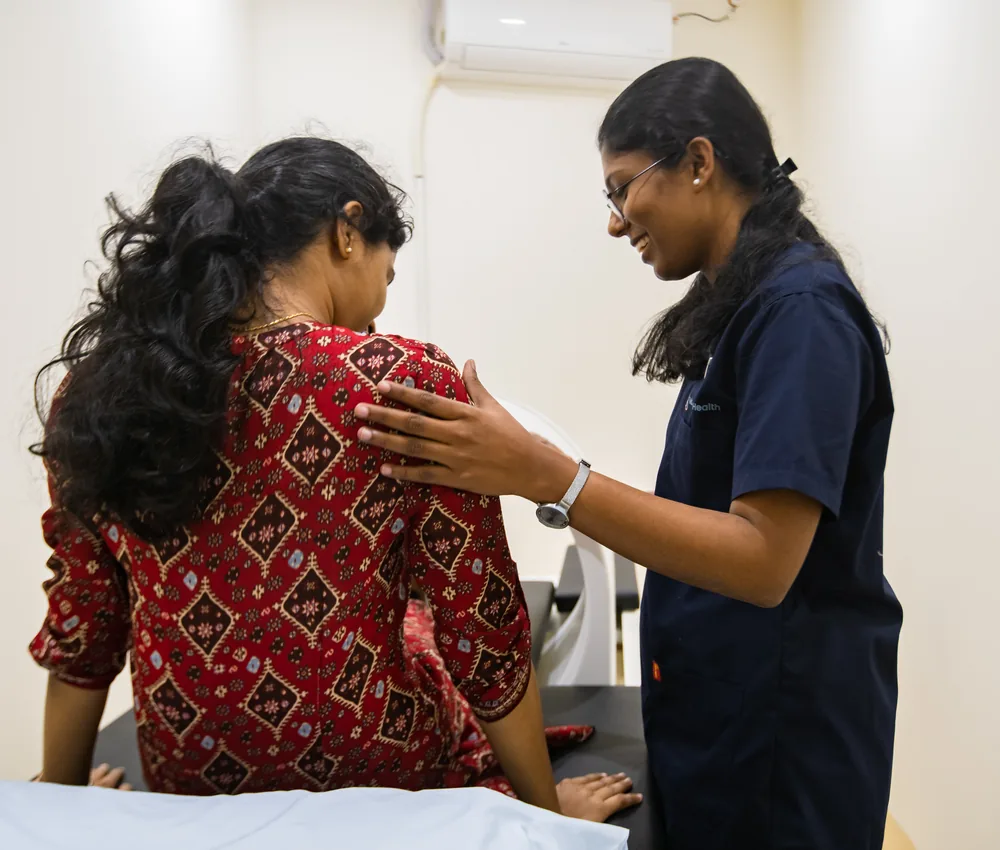
At your Maana Spine assessment, your physiotherapist will:
- ask about your symptoms, how they started and what makes them better or worse
- check how your back moves, and test the strength, sensation and reflexes in your legs
- use special tests to see whether a nerve is irritated
- review any MRI, X-ray or lab reports you bring
You'll get a physiotherapy diagnosis and a personalised plan. You don't need a scan to book; if one would help, your physiotherapist will recommend an MRI or X-ray.
How we treat a disc bulge at Maana Spine
A disc bulge is treated through Maana Spine DTX™, our personalised, non-surgical Precision Spine Care program.
- Assess: we work out whether the bulge is behind your pain, what else may be contributing, and rule out red flags.
 Decompress: where it suits your condition, computer-controlled spinal decompression using US FDA 510(k)-cleared technology, set for the level of your affected disc. If decompression isn't suitable, we use other therapies, such as pulsed signal therapy (PST).
 Restore: gentle movement, mobility work and physiotherapist-led stretching to ease pain and stiffness.
 Strengthen: our four-level exercise roadmap (Level 1 Restore, Level 2 Stabilise, Level 3 Strengthen, Level 4 Maintain) to build core strength and support your spine.
 Empower: how to sit, lift, sleep and work in ways that reduce the load on your discs, with written and app-based home exercise programmes.
 Maintain: in-person follow-up at 1, 3, 6 and 12 months. The 1- and 3-month follow-ups are included in your program fee; the 6- and 12-month reviews are charged separately.
If your pain is severe and recent, we focus on easing it first, then start decompression once your symptoms settle.
A DTX program is typically 15 to 25 sessions of 60 to 75 minutes each, usually with the same physiotherapist throughout.
What the research says
Exercise. A 2021 Cochrane review, one of the most rigorous types of evidence, found moderate-certainty evidence that exercise probably reduces pain in long-lasting low back pain, by an amount that makes a real difference to patients. Structured exercise is at the core of every DTX program.
Spinal decompression. The research is still developing, and results depend on who was studied:
- In a 2022 sham-controlled trial, people with a recent disc herniation and leg pain who had real decompression had less leg pain and better function than those given a sham treatment, and their herniations shrank more on MRI. Low back pain itself didn't differ between the groups.
- A 2009 sham-controlled trial in people with long-lasting back pain from a bulging or worn disc, without leg pain, found both groups improved, with no significant difference between them.
- These trials studied different patients. One possible explanation is that decompression helps most when a disc is pressing on a nerve, but two trials aren't enough to confirm that.
- In the small trials so far, pain relief has been similar between decompression and traditional traction. Some found added benefits from decompression for day-to-day function, disc measurements on MRI and patient satisfaction. The clearest finding is that either works better combined with structured physiotherapy than physiotherapy alone.
Do bulges shrink on their own? Sometimes. A 2015 review found that bulges were the disc problem least likely to shrink without treatment (about 13%), compared with about 41% of protrusions and higher rates for larger herniations. Scan changes don't always match how people feel.
That's why we don't rely on one treatment. Decompression, where it suits you, is one part of a program built around exercise and movement.
Will I need surgery for a disc bulge?
Most people with a disc bulge don't need surgery. Non-surgical care is a reasonable first step for most people, and surgery stays available if you need it. If your assessment suggests you should see a surgeon, for example because of worsening weakness or symptoms that aren't improving, we'll tell you honestly.
Living with a disc bulge: practical tips
- Keep moving. Gentle activity, such as short walks, is usually better than long periods of rest.
- Break up sitting. Stand up and move regularly, and break up long car or two-wheeler journeys.
- Lift with care. Keep loads close to your body and avoid twisting while lifting.
- Don't fear your scan. A bulge on an MRI doesn't mean your spine is badly damaged.
These are general tips, not a substitute for an assessment.
When to book a spine assessment
Book an assessment if your back pain:
- hasn't eased after a couple of weeks, or keeps coming back
- spreads into your leg, or comes with numbness or tingling
- stops you working, sleeping or doing what you enjoy
- has been linked to a disc bulge on a scan and you want to know your options
Spine assessments are available at all five Maana Spine clinics in Kochi, Kozhikode, Thiruvananthapuram, Aluva and Perinthalmanna. The consultation fee is ₹250, and no doctor's referral is needed.
Book a Spine Assessment · or call or WhatsApp +91 99950 09403
What patients say

I was struggling with lower back pain that radiated down my leg, which made even daily activities difficult. The therapies and the care from the doctors and therapists at Maana Health helped me manage the pain and get back to my normal routine. I would definitely recommend Maana Health to anyone looking for non-surgical treatment options for back pain.
Ashraf T.M.Lumbar disc bulge

I was in severe pain and received treatment at Maana Health. The proper treatment and therapies here helped reduce my pain significantly and improved my condition. I would recommend Maana Health to anyone looking for non-surgical treatment options for spine-related problems.
SimiDisc bulge
Shared with each patient's written consent. These are individual experiences; results vary.
Frequently asked questions
Is a disc bulge serious?
Usually not. Disc bulges are very common, including in people with no pain. A bulge needs urgent attention only if it comes with warning signs such as numbness around your genitals or bottom, bladder or bowel changes, or worsening leg weakness.
Can a disc bulge heal on its own?
Symptoms from disc problems often improve with time and the right care. A bulge is less likely to shrink on a scan than larger herniations, but scans don't always match how you feel: in a major sciatica trial, scans a year later still showed a disc herniation in about a third of people, whether or not they had recovered.
What is the difference between a disc bulge and a slipped disc?
In a bulge, the disc spreads out beyond its normal edge but its outer ring stays intact. In a slipped (herniated) disc, some of the soft centre pushes through the outer ring. Both can press on a nerve.
What is an L4-L5 or L5-S1 disc bulge?
These labels show where the bulge is: between the 4th and 5th lumbar vertebrae (L4-L5), or between the 5th lumbar vertebra and the sacrum (L5-S1). They're the most common levels for disc problems in the lower back.
Is spinal decompression good for a disc bulge?
It can be part of the plan where it suits your condition. Trials suggest decompression may help most when a disc is pressing on a nerve and causing leg pain; results are mixed in people with back pain only, where one trial found no difference from sham treatment. At Maana Spine, decompression is always combined with exercise-based rehabilitation.
Do I need an MRI for a disc bulge?
Not always. Your physiotherapist will recommend an MRI if your symptoms are severe or getting worse, if there are warning signs, or if a scan would change your treatment.
How long does treatment take?
A Maana Spine DTX™ program is typically 15 to 25 sessions of 60 to 75 minutes each. Your physiotherapist will suggest a plan after your assessment.
What exercises are good for a disc bulge?
It depends on your symptoms; some movements ease disc pain while others aggravate it. Your physiotherapist will show you exercises suited to your back, and you'll get written and app-based home programmes.
References
- Brinjikji W, et al. Systematic literature review of imaging features of spinal degeneration in asymptomatic populations. American Journal of Neuroradiology, 2015;36(4):811–816. doi.org/10.3174/ajnr.A4173
- Brinjikji W, et al. MRI findings of disc degeneration are more prevalent in adults with low back pain than in asymptomatic controls: a systematic review and meta-analysis. American Journal of Neuroradiology, 2015;36(12):2394–2399. doi.org/10.3174/ajnr.A4498
- Hayden JA, Ellis J, Ogilvie R, Malmivaara A, van Tulder MW. Exercise therapy for chronic low back pain. Cochrane Database of Systematic Reviews, 2021. doi.org/10.1002/14651858.CD009790.pub2
- Choi E, Gil HY, Ju J, Han WK, Nahm FS, Lee PB. International Journal of Clinical Practice, 2022. doi.org/10.1155/2022/6343837
- Schimmel JJP, et al. European Spine Journal, 2009;18(12):1843–1850. link.springer.com
- Adar S, et al. Cureus, 2024. ncbi.nlm.nih.gov/pmc/articles/PMC11420602
- el Barzouhi A, et al. New England Journal of Medicine, 2013. nejm.org/doi/full/10.1056/NEJMoa1209250
- Chiu CC, et al. Clinical Rehabilitation, 2015;29(2):184–195. doi.org/10.1177/0269215514540919