
Written by Ansu Susan Kuriakose, BPT · Clinically reviewed by Jasmal K, BPT, MPT · Last reviewed 5 October 2026
Cervical radiculopathy: arm pain from a "pinched nerve" in the neck
Pain that shoots from your neck into your shoulder, arm or hand, often with tingling or numbness, can be distressing and can keep you awake at night. It's usually caused by an irritated nerve in the neck, called cervical radiculopathy. The outlook is generally good: most people improve without surgery.
Book a Spine Assessment · or call or WhatsApp +91 99950 09403
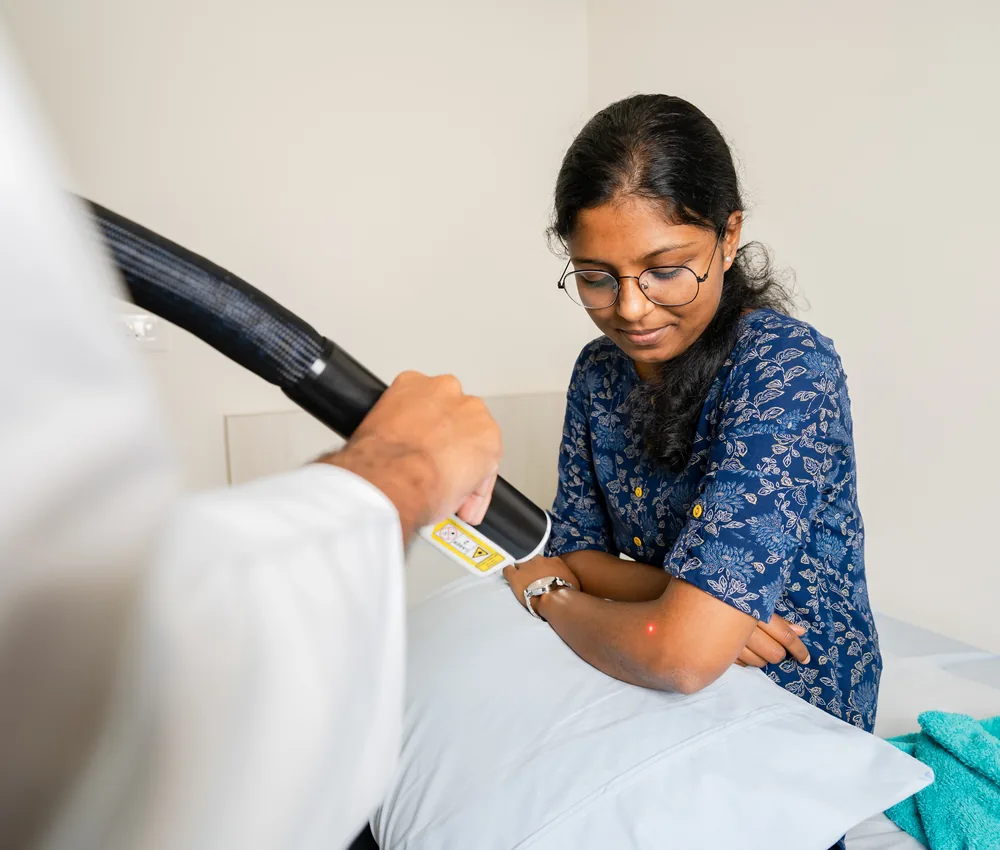
What is cervical radiculopathy?
Nerves leave your spinal cord through small openings between the bones of your neck and travel down into your arms. Radiculopathy means one of these nerve roots is irritated or compressed. It's the neck's version of sciatica.
Common causes include:
- a slipped (herniated) or bulging disc in the neck pressing on a nerve root
- age-related changes such as bone spurs narrowing the opening the nerve passes through (cervical spondylosis)
Symptoms
- pain spreading from your neck into your shoulder blade, arm or hand
- pins and needles, tingling or numbness in part of your arm or fingers
- weakness in your arm or grip
- pain that's worse with certain neck movements, such as looking up or turning towards the painful side
- for some people, relief from resting the hand on top of the head
Usually only one arm is affected. Symptoms in both arms or hands need a doctor's assessment.
When neck pain needs urgent help
How long does it take to recover?
For most people, the outlook is good. A 2014 review found that most people with arm pain from a neck disc herniation improve substantially within 4 to 6 months, and full recovery often takes 2 to 3 years. The quality of research on this was limited, and some people do have lasting symptoms. That's why a structured plan, and keeping an eye on any weakness, matters.
How it's diagnosed
At your Maana Spine assessment, your physiotherapist asks about your symptoms, checks how your neck moves, tests the strength, sensation and reflexes in your arms, and uses special tests to see which nerve root is irritated. Any MRI, X-ray or lab reports you bring are reviewed.
You'll get a physiotherapy diagnosis and a personalised plan. You don't need a scan to book; your physiotherapist will recommend an MRI if your symptoms are severe or getting worse, or if a scan would change your treatment.
How we treat cervical radiculopathy at Maana Spine
Treatment follows Maana Spine DTX™, our personalised, non-surgical Precision Spine Care program:
 Assess: we identify which nerve is involved, check your strength and rule out red flags.
 Decompress: where it suits your condition, computer-controlled spinal decompression with cervical positioning, using US FDA 510(k)-cleared technology. If your pain is severe and recent, we focus on easing it first. If decompression isn't suitable, we use other therapies, such as pulsed signal therapy (PST).
 Restore: gentle, nerve-friendly movement, mobility work and physiotherapist-led stretching.
 Strengthen: our four-level exercise roadmap (Level 1 Restore, Level 2 Stabilise, Level 3 Strengthen, Level 4 Maintain) for the neck, shoulder and upper-back muscles.
 Empower: positions and habits that calm the nerve at work, on your phone, on two-wheelers and in bed, with written and app-based home exercise programmes.
 Maintain: in-person follow-up at 1, 3, 6 and 12 months. The 1- and 3-month follow-ups are included in your program fee; the 6- and 12-month reviews are charged separately.
A DTX program is typically 15 to 25 sessions of 60 to 75 minutes each, usually with the same physiotherapist throughout.
What the research says
Guideline. The 2017 neck pain guideline from the American Physical Therapy Association suggests that, for neck pain spreading into the arm, intermittent neck traction may help when combined with manual therapy and strengthening exercises.
Decompression for the neck. A 2019 double-blind trial of 40 people with a disc problem at the C5-C6 level found pain improved in both groups, while function and disc measurements improved more with traction designed to keep the neck's natural curve. Research on the neck is thinner than for the lower back.
Recovery. Most people improve substantially within 4 to 6 months, as described above.
When radiculopathy may need surgery
Surgery is considered for weakness that's severe or getting worse, signs of pressure on the spinal cord, or severe pain that hasn't improved with a good trial of non-surgical care. Non-surgical care is a reasonable first step for most people, and surgery stays available. If your assessment suggests you should see a surgeon, we'll tell you honestly.
Practical tips
- Find positions that ease your arm pain. Some people find resting the hand on top of the head helps.
- Avoid long spells looking up or holding your neck in one position.
- Support your neck at night with a pillow that keeps it comfortable.
- Keep gently active. Movement within comfort usually helps more than rest.
These are general tips, not a substitute for an assessment.
When to book a spine assessment
Book an assessment if you have pain, tingling or numbness spreading from your neck into your arm, especially if it hasn't settled within a couple of weeks or comes with weakness. Spine assessments are available at all five Maana Spine clinics in Kochi, Kozhikode, Thiruvananthapuram, Aluva and Perinthalmanna. The consultation fee is ₹250, and no doctor's referral is needed.
Book a Spine Assessment · or call or WhatsApp +91 99950 09403
Frequently asked questions
How long does cervical radiculopathy last?
Most people improve substantially within 4 to 6 months, and full recovery often takes 2 to 3 years. Get assessed if you have weakness or symptoms that aren't improving.
Can a pinched nerve in the neck heal on its own?
Often, yes. Most people improve without surgery. A structured plan helps you manage pain and rebuild strength while it settles.
Is cervical radiculopathy serious?
Usually not, but weakness that's getting worse, symptoms in both arms, or clumsy hands and unsteadiness need a doctor's assessment.
Can decompression help cervical radiculopathy?
It can be part of the plan where it suits your condition. A US physical therapy guideline suggests traction may help arm pain from the neck when combined with exercise and manual therapy. At Maana Spine, decompression is always combined with exercise-based rehabilitation.
Do I need an MRI?
Not always. An MRI is usually recommended if symptoms are severe or getting worse, if there's weakness, or if surgery is being considered.
Which sleeping position helps a pinched nerve in the neck?
It varies. Many people find lying on their back, or on the side that isn't painful, with a pillow that keeps the neck level, most comfortable.
References
- Wong JJ, Côté P, Quesnele JJ, Stern PJ, Mior SA. The course and prognostic factors of symptomatic cervical disc herniation with radiculopathy: a systematic review of the literature. The Spine Journal, 2014;14(8):1781–1789. doi.org/10.1016/j.spinee.2014.02.032
- Blanpied PR, Gross AR, Elliott JM, et al. Neck Pain: Revision 2017. Journal of Orthopaedic & Sports Physical Therapy, 2017;47(7):A1–A83. doi.org/10.2519/jospt.2017.0302
- Lee CH, et al. International Journal of Environmental Research and Public Health, 2019;16(12):2162. doi.org/10.3390/ijerph16122162
- Davies BM, et al. BMJ, 2018. ncbi.nlm.nih.gov/pmc/articles/PMC6074604