
Written by Ansu Susan Kuriakose, BPT · Clinically reviewed by Jasmal K, BPT, MPT · Last reviewed 5 October 2026
Lumbar spinal stenosis: leg pain when walking, and how it's treated
Do your legs ache, feel heavy or go numb when you walk, and get better when you sit down or lean forward? That pattern is typical of lumbar spinal stenosis, a narrowing of the space around the nerves in your lower back. It's more common after age 50.
Stenosis can be frustrating because it limits how far you can walk. But surgery isn't the only answer, and for many people a structured, non-surgical program is a reasonable place to start.
Book a Spine Assessment · or call or WhatsApp +91 99950 09403

What is lumbar spinal stenosis?
Your spinal nerves run through a canal in the middle of your spine, and branch out through openings on each side. Stenosis means narrowing. In lumbar spinal stenosis, the canal or these openings narrow in the lower back and squeeze the nerves.
It's usually caused by age-related changes (lumbar spondylosis), such as:
- discs losing height and bulging backwards (disc bulge)
- the facet joints enlarging and forming bone spurs
- thickening of a ligament at the back of the canal
- one vertebra slipping forward over another (spondylolisthesis)
Symptoms
The classic symptom is neurogenic claudication:
- pain, aching, heaviness, numbness or tingling in your buttocks and legs when you walk or stand for a while
- symptoms that ease when you sit down or bend forward, for example leaning on a shopping trolley or walking stick
- being able to walk less far than before
You may also have lower back pain, and leg symptoms can affect one or both legs.
When stenosis is an emergency
Not sure if it's your back or your circulation? Leg pain on walking can also come from narrowed arteries in the legs. If you have diabetes, smoke, or have heart or circulation problems, ask a doctor to check your circulation too.
How it's diagnosed
At your Maana Spine assessment, your physiotherapist asks how far you can walk, what eases your symptoms, and checks how your back moves and the strength, sensation and reflexes in your legs. Any MRI, X-ray or lab reports you bring are reviewed. You'll get a physiotherapy diagnosis and a personalised plan.
You don't need a scan to book. If one would help, your physiotherapist will recommend an MRI or X-ray.
How we treat lumbar spinal stenosis at Maana Spine
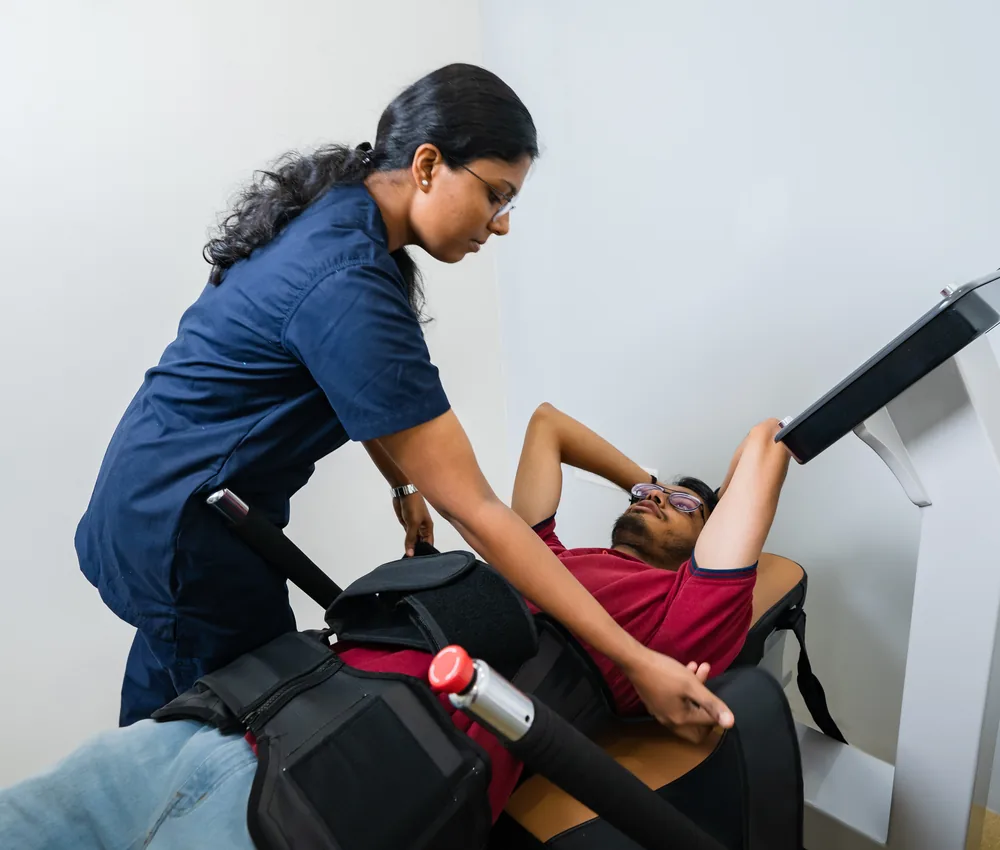
Treatment follows Maana Spine DTX™, our personalised, non-surgical Precision Spine Care program, adapted to stenosis:
 Assess: we confirm the pattern of your symptoms, check your walking tolerance and rule out red flags.
 Decompress: where it suits your condition, computer-controlled spinal decompression using US FDA 510(k)-cleared technology. If decompression isn't suitable, we use other therapies, such as pulsed signal therapy (PST).
 Restore: mobility work, often including positions that open up the spinal canal, plus physiotherapist-led stretching.
 Strengthen: our four-level exercise roadmap (Level 1 Restore, Level 2 Stabilise, Level 3 Strengthen, Level 4 Maintain), with a gradual plan to build your walking distance.
 Empower: strategies for walking, standing and daily tasks, with written and app-based home exercise programmes.
- Maintain: in-person follow-up at 1, 3, 6 and 12 months. The 1- and 3-month follow-ups are included in your program fee; the 6- and 12-month reviews are charged separately.
A DTX program is typically 15 to 25 sessions of 60 to 75 minutes each, usually with the same physiotherapist throughout.
What the research says
Surgery or non-surgical care? A 2016 Cochrane review combined five randomised trials involving 643 people with lumbar spinal stenosis:
- The reviewers had very little confidence that either surgery or non-surgical care was better.
- Disability was similar at six months and one year. At two years there was a small difference in favour of surgery (about 4 points on a 0 to 100 scale).
- In the studies that reported them, complications occurred in 10% to 24% of people who had surgery.
- The reviewers advised caution in proposing surgery.
Non-surgical treatment has its own drawbacks, including that it takes time and effort. This review is one reason we think non-surgical care is a reasonable first step for most people.
Decompression. None of the decompression trials we've reviewed studied people with spinal stenosis specifically. Your physiotherapist will decide during your assessment whether decompression suits your condition.
When stenosis may need surgery
Surgery is worth discussing with a spine surgeon if your symptoms are severe, keep getting worse, cause weakness, or haven't improved with a good trial of non-surgical care. Surgery stays available, and if your assessment suggests you should see a surgeon, we'll tell you honestly.
Living with spinal stenosis: practical tips
- Use positions that help. Sitting, or leaning forward slightly (for example on a trolley or walking stick), often eases leg symptoms.
- Walk little and often. Short walks with rests may help you stay active while you build your tolerance.
- Try a stationary bike. Many people with stenosis find cycling easier than walking, because you lean forward.
- Keep up your home programme. Regular practice makes the biggest difference.
These are general tips, not a substitute for an assessment.
When to book a spine assessment
Book an assessment if leg pain, heaviness or numbness limits how far you can walk, or if back pain has lasted more than a few weeks. Spine assessments are available at all five Maana Spine clinics in Kochi, Kozhikode, Thiruvananthapuram, Aluva and Perinthalmanna. The consultation fee is ₹250, and no doctor's referral is needed.
Book a Spine Assessment · or call or WhatsApp +91 99950 09403
Frequently asked questions
What are the first signs of lumbar spinal stenosis?
Often, leg pain, heaviness, numbness or tingling that comes on when you walk or stand and eases when you sit or bend forward. You may notice you can't walk as far as you used to.
Can lumbar spinal stenosis be treated without surgery?
Many people manage stenosis with non-surgical care. A 2016 Cochrane review found no clear advantage of surgery over non-surgical treatment at six months and one year, with only a small difference at two years. Surgery remains an option if symptoms are severe or getting worse.
Is walking good for spinal stenosis?
Staying active is important. Short, regular walks with rests, and positions that ease your symptoms, can help you keep moving while you build tolerance.
Is spinal decompression safe for stenosis?
It depends on your condition. Your physiotherapist checks whether decompression suits you during your assessment. If it doesn't, your DTX plan uses other therapies.
Does spinal stenosis get worse over time?
It varies. Some people stay stable for years; others find their walking gets shorter. Get assessed if your symptoms are changing, and seek emergency help for the warning signs on this page.
Why does bending forward help?
Bending forward slightly opens up the spinal canal and the spaces where the nerves exit, which can take pressure off them.
What's the difference between spinal stenosis and sciatica?
Sciatica describes pain spreading down the leg from an irritated nerve. Stenosis is one possible cause of it, and typically causes leg symptoms when walking that ease with sitting.
→ Read about sciatica
References
- Zaina F, Tomkins-Lane C, Carragee E, Negrini S. Surgical versus non-surgical treatment for lumbar spinal stenosis. Cochrane Database of Systematic Reviews, 2016;(1):CD010264. doi.org/10.1002/14651858.CD010264.pub2
- Royal Free London NHS Foundation Trust. Cauda equina syndrome: patient information. royalfree.nhs.uk