
Written by Ansu Susan Kuriakose, BPT · Clinically reviewed by Jasmal K, BPT, MPT · Last reviewed 5 October 2026
Slipped disc (herniated disc): non-surgical treatment that targets the cause
Being told you have a "slipped disc" can be frightening, especially if you've been warned you might need surgery. The reassuring news is that most people with a herniated disc improve without an operation, and research shows many herniated discs shrink over time.
At Maana Spine, we treat slipped and herniated discs without surgery, through a personalised program combining spinal decompression, where it suits you, with structured rehabilitation.
Book a Spine Assessment · or call +91 99950 09403
What is a slipped disc?
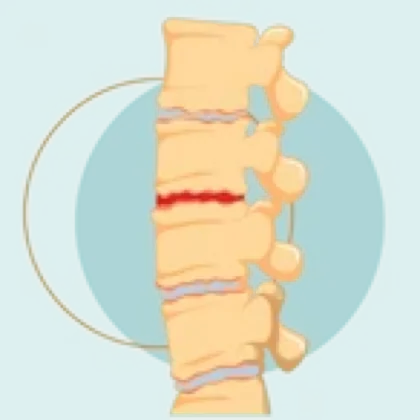
Between each of the bones (vertebrae) in your spine sits a disc: a tough outer ring with a softer, gel-like centre. It acts as a cushion and lets your spine bend and twist.
A herniated disc happens when part of that soft centre pushes out through a weak point in the outer ring. Despite the name, the disc doesn't actually "slip" out of place. "Slipped disc," "disc slip," "prolapsed disc" and "disc complaint" are everyday names for the same problem.
The herniated material can press on or irritate a nearby nerve. That's why a slipped disc often causes pain, numbness or tingling in the leg, not just the back.
Most slipped discs happen in the lower back (lumbar spine), usually at the two lowest levels, L4-L5 and L5-S1. They can also happen in the neck (cervical spine), where they cause pain spreading into the shoulder and arm.
Symptoms of a slipped disc
In the lower back:
- Pain spreading from the buttock down the back or side of the leg, often below the knee (sciatica)
- Leg pain that's often worse than the back pain
- Numbness, tingling or "pins and needles" in the leg or foot
- Weakness in the leg or foot, such as difficulty standing on your toes or heels
- Pain that's worse when sitting, bending forward, coughing or sneezing
In the neck:
- Neck pain spreading into the shoulder, arm or hand
- Numbness, tingling or weakness in the arm or hand
Nerve pain from the neck (cervical radiculopathy)
Some people with a herniated disc on an MRI have no symptoms at all.
What causes a slipped disc?
Discs naturally lose water and become less flexible with age, which makes the outer ring more likely to tear. A herniation can then happen gradually, or suddenly with lifting, twisting or a sudden movement.
Factors that may increase the risk include heavy or repetitive lifting, long periods of sitting, being overweight, smoking, and a family history of disc problems.
When a slipped disc is an emergency
Rarely, a large disc herniation presses on the bundle of nerves at the bottom of the spinal canal, a condition called cauda equina syndrome. Go to a hospital emergency department straight away if you have:
- numbness around your genitals, inner thighs or bottom
- new difficulty passing urine, or loss of bladder or bowel control
- leg weakness that's getting worse, or sciatica in both legs
Can a slipped disc heal on its own?
Often, yes. Studies that have followed people with herniated discs using repeat MRI scans show that herniated disc material frequently shrinks or disappears without surgery. A systematic review of these studies found that the larger and more "escaped" the herniation, the more likely it was to regress:
| Type of herniation | What it means | Chance of spontaneous regression |
|---|---|---|
| Sequestration | A fragment has broken free from the disc | About 96% |
| Extrusion | Disc material has pushed well beyond the disc | About 70% |
| Protrusion | Disc material has pushed out, but stays mostly contained | About 41% |
| Bulge | The disc extends evenly beyond its normal edge | About 13% |
Your MRI report usually names which type you have. Changes on a scan don't always match how you feel, and many people's symptoms improve before the disc visibly shrinks.
This is an important reason why a structured non-surgical program is the usual first step for most people with a herniated disc.
How we treat a slipped disc at Maana Spine
A slipped disc is treated through Maana Spine DTX™, our personalised, non-surgical Precision Spine Care program.
 Assess: we review your symptoms, test your nerves, strength and reflexes, and look at your MRI if you have one. We check for warning signs that need medical care first.
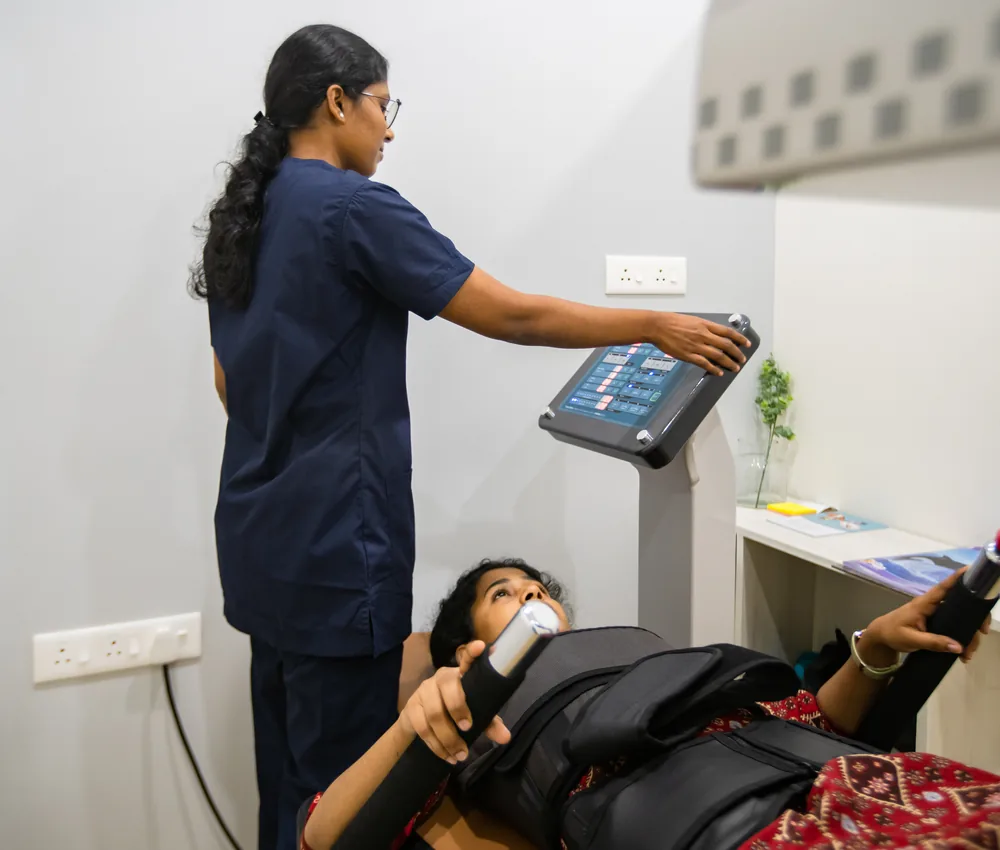
 Decompress: for many people with a herniated disc, especially with leg pain, computer-controlled spinal decompression is a central part of the plan. Force, angle and stabilisation are set for the affected disc level. If your pain is severe and recent, we start by easing it, then move on to decompression once your symptoms settle.
 Restore: mobility, nerve-friendly movement and physiotherapist-led stretching.
 Strengthen: a structured Level 1 to Level 4 exercise progression to build core strength and spinal stability.
 Empower: how to sit, lift, sleep and work in ways that protect your disc.
 Maintain: in-person follow-up at 1, 3, 6 and 12 months after your program ends. The 1- and 3-month follow-ups are included in your program fee; the 6- and 12-month reviews are charged separately.
A DTX program is typically 15 to 25 sessions of 60 to 75 minutes each.
Explore Maana Spine DTX™
How non-surgical spinal decompression works
What the research says about decompression for a slipped disc
A herniated disc with leg pain is where the evidence for spinal decompression is strongest.
- Compared with a sham treatment: in a 2022 randomised trial of 60 people with a recently herniated lower-back disc, real decompression led to less leg pain at two months, better day-to-day function at two and three months, and greater shrinkage of the herniation on MRI (about 28% on average, against about 7% with the sham). Because the sham group was also followed with MRI, this result accounts for natural shrinkage. Lower back pain improved similarly in both groups.
- Added to physiotherapy: a 2022 randomised trial in people with nerve pain from the lower back found that adding decompression to routine physiotherapy improved pain, movement and function more than physiotherapy alone.
There are limits: most studies are small, with short follow-up. That's why decompression at Maana Spine is always part of a wider rehabilitation program, never offered on its own.
Do I need surgery for a slipped disc?
Most people don't. Surgery to remove the herniated part of the disc (a discectomy) can be the right choice in some situations:
- Straight away, as an emergency, if you have signs of cauda equina syndrome
- Urgently, if leg weakness is severe or getting worse
- When non-surgical care hasn't worked. NICE recommends considering surgery for sciatica when non-surgical treatment hasn't improved pain or function, and the MRI findings match the symptoms.
If your progress during DTX isn't what it should be, your physiotherapist will tell you honestly and help you decide whether to see a spine surgeon. Choosing a non-surgical program first doesn't rule out surgery later.
Living with a slipped disc: practical tips
- Stay as active as you can. Gentle walking is usually better than bed rest.
- Break up sitting. Sitting often makes disc pain worse. Stand and move regularly.
- Avoid heavy lifting and twisting while your symptoms are flaring.
- Don't push through sharp or spreading pain during exercise. Your physiotherapist will show you which movements suit your disc.
These are general tips, not a substitute for an assessment.
Book a spine assessment
Spine assessments are available at all five Maana Spine clinics in Kochi, Kozhikode, Thiruvananthapuram, Aluva and Perinthalmanna. The consultation fee is ₹250, and no doctor's referral is needed. Bring your MRI and any other reports you have.
Book a Spine Assessment · or call +91 99950 09403
What patients say

I was struggling with lower back pain that radiated down my leg, which made even daily activities difficult. The therapies and the care from the doctors and therapists at Maana Health helped me manage the pain and get back to my normal routine. I would definitely recommend Maana Health to anyone looking for non-surgical treatment options for back pain.
Ashraf T.M.Lumbar disc bulge

I was in severe pain and received treatment at Maana Health. The proper treatment and therapies here helped reduce my pain significantly and improved my condition. I would recommend Maana Health to anyone looking for non-surgical treatment options for spine-related problems.
SimiDisc bulge
Shared with each patient's written consent. These are individual experiences; results vary.
Frequently asked questions
Can a slipped disc be treated without surgery?
Yes. Most people with a slipped (herniated) disc improve without surgery. A structured non-surgical program is the usual first step, and surgery is generally reserved for emergencies, severe or worsening weakness, or when non-surgical care hasn't helped.
Can a herniated disc heal on its own?
Often, yes. Studies using repeat MRI scans show herniated disc material frequently shrinks over time, especially larger herniations. A systematic review found regression in about 70% of extrusions and about 96% of sequestrations.
How long does a slipped disc take to heal?
It varies. Many people's symptoms improve over weeks to a few months. A DTX program typically runs 15 to 25 sessions, and your physiotherapist will give you a clearer idea after your assessment.
Is spinal decompression good for a slipped disc?
A herniated disc with leg pain is where decompression has its strongest evidence. In a sham-controlled trial, decompression reduced leg pain and shrank herniations more than a sham treatment. At Maana Spine, it's always combined with rehabilitation.
Is a slipped disc the same as a bulging disc?
Not quite. In a bulging disc, the disc extends evenly beyond its normal edge. In a herniated (slipped) disc, part of the soft centre pushes out through a weak point in the outer ring. Herniations are more likely to press on a nerve.
Should I rest or keep moving with a slipped disc?
Gentle movement, such as walking, is usually better than bed rest. Avoid heavy lifting and twisting while symptoms are flaring, and get assessed if pain is severe or spreading.
Can a slipped disc in the neck be treated without surgery?
Yes, in most cases. DTX includes positioning and approaches specific to the neck, and decompression can be applied to the cervical spine where suitable.
When should I see a doctor urgently?
Go to a hospital emergency department straight away if you have numbness around your genitals or bottom, new problems with bladder or bowel control, or leg weakness that's getting worse.
References
- Chiu CC, Chuang TY, Chang KH, Wu CH, Lin PW, Hsu WY. The probability of spontaneous regression of lumbar herniated disc: a systematic review. Clinical Rehabilitation, 2015;29(2):184–195. doi.org/10.1177/0269215514540919
- Choi E, et al. Effect of nonsurgical spinal decompression on intensity of pain and herniated disc volume in subacute lumbar herniated disc. International Journal of Clinical Practice, 2022. doi.org/10.1155/2022/6343837
- Non-surgical decompression therapy in addition to routine physical therapy versus routine physical therapy alone in patients with lumbar radiculopathy: a randomized controlled trial. 2022. pubmed.ncbi.nlm.nih.gov/35296293
- National Institute for Health and Care Excellence (NICE). Low back pain and sciatica in over 16s: assessment and management (NG59). 2016, last updated July 2026. nice.org.uk/guidance/ng59/chapter/recommendations
- Royal Free London NHS Foundation Trust. Cauda equina syndrome: patient information. royalfree.nhs.uk/patients-and-visitors/patient-information-leaflets/cauda-equina-syndrome