
Written by Ansu Susan Kuriakose, BPT · Clinically reviewed by Jasmal K, BPT, MPT · Last reviewed 5 October 2026
Degenerative disc disease: what it means and how it's treated without surgery
"Degenerative disc disease" sounds worrying, as if your spine is wearing out and will only get worse. In reality, it isn't really a disease. It's a name for changes in the spinal discs that happen to almost everyone with age. For some people, these changes cause pain; for many, they don't.
If they are causing your pain, there's a lot you can do about it without surgery.
Book a Spine Assessment · or call or WhatsApp +91 99950 09403
What is degenerative disc disease?
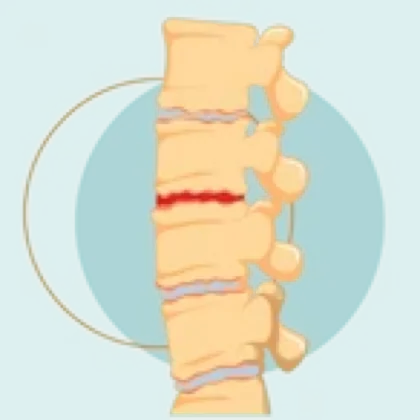
The discs between the bones of your spine have a tough outer ring and a soft, water-rich centre. Over time, discs naturally:
- lose water (your MRI report may call this disc desiccation)
- lose height, so the space between the vertebrae narrows
- develop small tears in the outer ring
These changes are called disc degeneration. When they're thought to be causing pain, doctors and physiotherapists often call it degenerative disc disease. It's most common in the lower back and the neck.
Degenerative disc changes often happen alongside other age-related changes in the spine, such as lumbar spondylosis, a disc bulge or narrowing of the spinal canal (spinal stenosis).
How common is it?
Very common, and mostly harmless. A large 2015 review of scans in people with no back pain found disc degeneration in about 37% of 20-year-olds, rising to about 96% of 80-year-olds. The authors concluded that many of these changes are part of normal ageing.
However, in adults aged 50 or under, a second review found disc degeneration was more common in people with back pain than in people without. So disc changes can contribute to pain, especially in younger adults, but a scan finding alone doesn't prove it's the cause.
Symptoms
Degenerative disc changes often cause no symptoms. When they do, you may notice:
- a long-lasting ache in your lower back (or neck), sometimes with flare-ups
- pain that's worse after sitting for a long time, bending or lifting
- stiffness, especially in the morning or after rest
- pain that eases when you move around or change position
- if a nerve is irritated: pain, numbness or tingling spreading into a leg (or arm)
What causes it?
- Age. Discs gradually lose water and height over the years.
- Load. Heavy physical work, repeated bending and long hours of sitting may speed up changes.
- Other factors, such as genetics, smoking, excess body weight and previous injury, may play a part.
When back pain is an emergency
How it's diagnosed
At your Maana Spine assessment, your physiotherapist takes a detailed history, checks how your spine moves, tests the nerves in your legs or arms, and reviews any MRI, X-ray or lab reports you bring. Because disc degeneration is so common on scans, the aim is to work out whether it's really behind your pain, and what else may be contributing, such as muscle weakness, stiff joints or how you sit and move.
You'll get a physiotherapy diagnosis and a personalised plan. You don't need a scan to book; if one would help, your physiotherapist will recommend an MRI or X-ray.
How we treat degenerative disc disease at Maana Spine
Treatment follows Maana Spine DTX™, our personalised, non-surgical Precision Spine Care program, adapted to your condition:
 Assess: we find out what's driving your pain and rule out red flags.
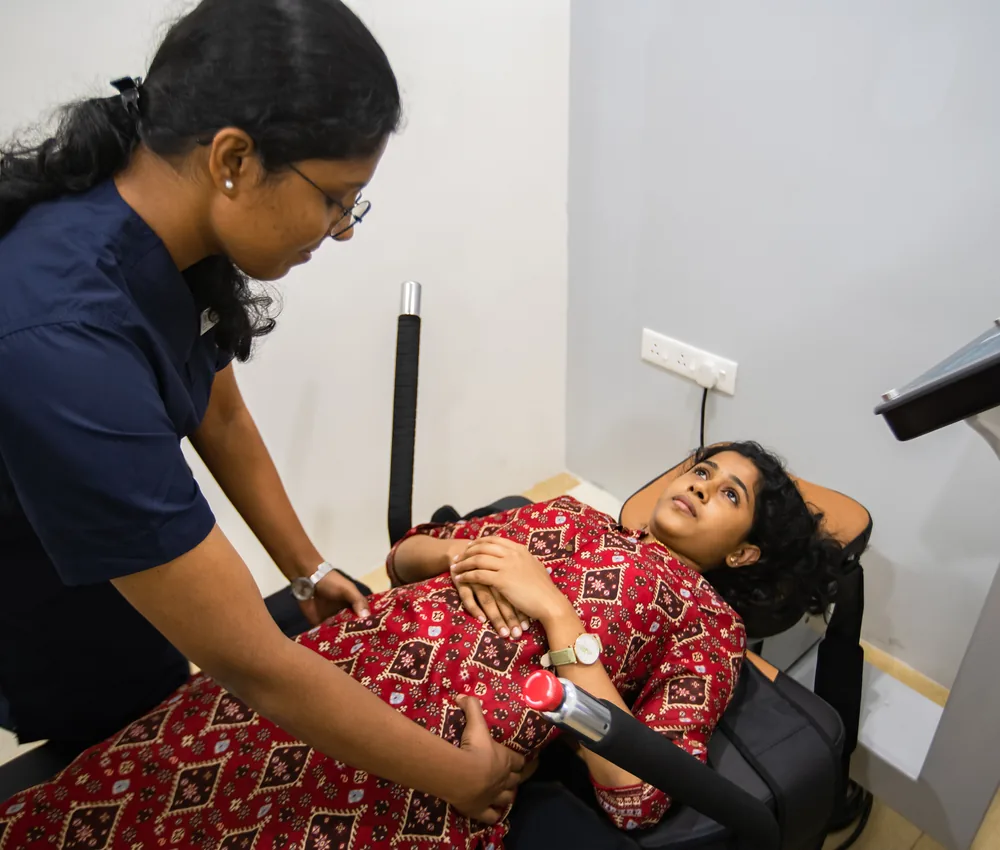
 Decompress: where it suits your condition, computer-controlled spinal decompression using US FDA 510(k)-cleared technology, set for the level of the affected disc. If decompression isn't suitable, we use other therapies, such as pulsed signal therapy (PST).
 Restore: gentle movement, mobility work and physiotherapist-led stretching to ease stiffness.
 Strengthen: our four-level exercise roadmap (Level 1 Restore, Level 2 Stabilise, Level 3 Strengthen, Level 4 Maintain) to build the muscles that support your spine.
 Empower: how to sit, lift, sleep and work in ways that reduce strain, with written and app-based home exercise programmes.
 Maintain: in-person follow-up at 1, 3, 6 and 12 months. The 1- and 3-month follow-ups are included in your program fee; the 6- and 12-month reviews are charged separately.
A DTX program is typically 15 to 25 sessions of 60 to 75 minutes each, usually with the same physiotherapist throughout.
What the research says
Exercise. A 2021 Cochrane review found moderate-certainty evidence that exercise probably reduces pain in long-lasting low back pain, by an amount that makes a real difference to patients. Exercise is the foundation of every DTX program.
Spinal decompression. Results are mixed outside disc herniation with leg pain, and we'd rather you know that:
- A 2009 sham-controlled trial in people with long-lasting back pain from disc degeneration or a bulging disc, without leg pain, found both groups improved, with no significant difference between real and sham decompression.
- A 2019 double-blind trial in people with lumbar disc disease found pain improved in both groups, while day-to-day function and space in the spinal canal improved more with traction designed to keep the spine's natural curve.
- A 2010 study found that restored disc height after a six-week decompression course was linked to less low back pain. It had no comparison group, and it was sponsored by a company acting for the maker of the device studied.
- Overall, in the small trials so far, pain relief has been similar between decompression and traditional traction, and either works better combined with structured physiotherapy than physiotherapy alone.
PST (pulsed signal therapy). PST is a type of pulsed electromagnetic field (PEMF) therapy. A 2022 review of PEMF found it reduced long-lasting low back pain more than placebo or other treatments alone, though it didn't improve physical function. Another review suggested it helped most when added to other physiotherapy treatments. These studies used a range of PEMF devices, not necessarily PST.
Will I need surgery?
Most people with degenerative disc changes don't need surgery. Non-surgical care is a reasonable first step for most people, and surgery stays available if you need it. If your assessment suggests you should see a surgeon, we'll tell you honestly.
Living with degenerative disc disease: practical tips
- Keep active. Regular walking and the exercises from your programme help more than rest.
- Change position often. Avoid sitting or standing in one position for long stretches.
- Build strength gradually. Stronger supporting muscles can help your back cope with daily loads.
- Expect ups and downs. Flare-ups are common and usually settle. A flare-up doesn't mean your spine is getting worse.
These are general tips, not a substitute for an assessment.
When to book a spine assessment
Book an assessment if your back or neck pain keeps coming back, has lasted more than a few weeks, spreads into your leg or arm, or stops you doing what you need to. Spine assessments are available at all five Maana Spine clinics in Kochi, Kozhikode, Thiruvananthapuram, Aluva and Perinthalmanna. The consultation fee is ₹250, and no doctor's referral is needed.
Book a Spine Assessment · or call or WhatsApp +91 99950 09403
Frequently asked questions
Is degenerative disc disease a serious disease?
Usually not. Despite the name, it describes changes that happen to almost everyone's discs with age. Many people with these changes have no pain at all.
Does degenerative disc disease always get worse?
Disc changes generally continue with age, but pain doesn't necessarily follow the same path. Symptoms often come and go, and many people manage them well with exercise and good movement habits.
What does "disc desiccation" mean on my MRI report?
It means the disc has lost some of its water content. It's a common age-related change and doesn't by itself mean the disc is causing your pain.
Can spinal decompression help degenerative disc disease?
It may help some people. Results are mixed outside disc herniation with leg pain: one sham-controlled trial in people with back pain only (no leg pain) found no difference from sham treatment. At Maana Spine, decompression is used where it suits your condition and always alongside exercise-based rehabilitation.
Which exercises help degenerative disc disease?
There's no single exercise that suits everyone. Your physiotherapist will choose exercises based on your symptoms and how your back moves, and progress them through our four-level roadmap.
Is walking good for degenerative disc disease?
For most people, yes. Regular walking keeps your spine moving and is generally better than long periods of rest.
How long is the treatment?
A Maana Spine DTX™ program is typically 15 to 25 sessions of 60 to 75 minutes each, with follow-up afterwards.
References
- Brinjikji W, et al. Systematic literature review of imaging features of spinal degeneration in asymptomatic populations. American Journal of Neuroradiology, 2015;36(4):811–816. doi.org/10.3174/ajnr.A4173
- Brinjikji W, et al. MRI findings of disc degeneration are more prevalent in adults with low back pain than in asymptomatic controls: a systematic review and meta-analysis. American Journal of Neuroradiology, 2015;36(12):2394–2399. doi.org/10.3174/ajnr.A4498
- Hayden JA, Ellis J, Ogilvie R, Malmivaara A, van Tulder MW. Exercise therapy for chronic low back pain. Cochrane Database of Systematic Reviews, 2021. doi.org/10.1002/14651858.CD009790.pub2
- Schimmel JJP, et al. European Spine Journal, 2009;18(12):1843–1850. link.springer.com
- Lee CH, Heo SJ, Park SH, Jeong HS, Kim SY. Medicina, 2019. doi.org/10.3390/medicina56010004
- Apfel CC, et al. BMC Musculoskeletal Disorders, 2010. doi.org/10.1186/1471-2474-11-155
- Sun X, Huang L, Wang L, et al. Efficacy of pulsed electromagnetic field on pain and physical function in patients with low back pain: a systematic review and meta-analysis. Clinical Rehabilitation, 2022;36(5):636–649. pubmed.ncbi.nlm.nih.gov/35077249
- Kull P, Keilani M, Remer F, Crevenna R. Efficacy of pulsed electromagnetic field therapy on pain and physical function in patients with non-specific low back pain: a systematic review. Wiener Medizinische Wochenschrift. pmc.ncbi.nlm.nih.gov/articles/PMC11775040