
Written by Ansu Susan Kuriakose, BPT · Clinically reviewed by Jasmal K, BPT, MPT · Last reviewed 5 October 2026
Tailbone pain (coccydynia): pain at the base of the spine
Tailbone pain, called coccydynia, is pain at the very bottom of your spine. It's usually worst when you sit, especially leaning back, and when you stand up from sitting. It can be very uncomfortable, but most cases settle within weeks to months, and non-surgical treatment helps most people.
Book a Spine Assessment · or call or WhatsApp +91 99950 09403
What is coccydynia?
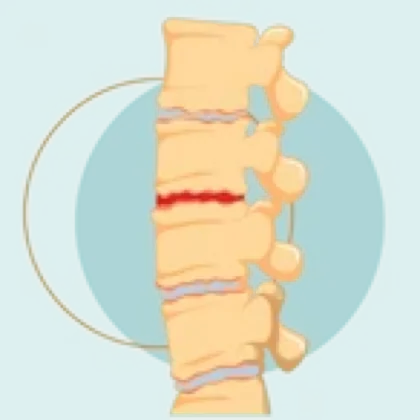
Your tailbone (coccyx) is the small, triangular bone at the bottom of your spine. When you sit, it shares your weight with your sitting bones. Coccydynia means pain in or around the tailbone.
Common causes:
- a fall onto your bottom, the most common cause
- childbirth
- long periods sitting on hard or narrow surfaces, including long rides
- sometimes no clear cause
Rarely, tailbone pain is caused by an infection or a tumour, which is why warning signs matter.
Symptoms
- pain at the base of the spine, just above the buttocks
- pain that's worse when sitting, especially leaning back
- pain when getting up from sitting
- tenderness when the tailbone is touched
When tailbone pain needs a doctor
How it's diagnosed
At your Maana Spine assessment, your physiotherapist asks how your pain started and which positions make it worse, checks your lower back, pelvis and hips, and reviews any X-ray or MRI reports you bring.
You'll get a physiotherapy diagnosis and a personalised plan. You don't need a scan to book; if one would help, your physiotherapist will recommend an MRI or X-ray.
How we treat tailbone pain at Maana Spine
Treatment follows Maana Spine DTX™, adapted to your tailbone pain:
 Assess: we work out what's causing your pain and rule out warning signs.
 Decompress: not usually needed for tailbone pain. If a lower back problem is also involved, decompression may be used where it suits your condition.
 Restore: physiotherapist-led stretching and release of the surrounding muscles, and other therapies such as shockwave therapy (ESWT) where suitable.
 Strengthen: our four-level exercise roadmap (Level 1 Restore, Level 2 Stabilise, Level 3 Strengthen, Level 4 Maintain) for the core, hip and buttock muscles.
 Empower: how to sit, stand up and choose seating that offloads your tailbone, with written and app-based home exercise programmes.
 Maintain: in-person follow-up at 1, 3, 6 and 12 months. The 1- and 3-month follow-ups are included in your program fee; the 6- and 12-month reviews are charged separately.
A DTX program is typically 15 to 25 sessions of 60 to 75 minutes each. Your physiotherapist will tell you after your assessment how many you're likely to need.
What the research says
Most people get better. An overview in the Ochsner Journal reports that most cases resolve within weeks to months, with or without treatment, and that non-surgical treatment helps in about 90% of cases. This figure is approximate and comes from older studies.
It isn't clear which treatment works most reliably. A 2013 systematic review found too little good-quality research to rank the non-surgical treatments. A 2025 review found physiotherapy approaches, particularly shockwave therapy (ESWT), promising.
Surgery to remove the tailbone is reserved for a small number of people whose pain doesn't improve with other treatment.
Practical tips
- Use a cushion with a cut-out or wedge shape so your tailbone doesn't press on the seat.
- Lean forward slightly when sitting, and avoid slouching back.
- Stand up slowly, leaning forward.
- Break up long rides and long spells of sitting.
These are general tips, not a substitute for an assessment.
When to book a spine assessment
Book an assessment if tailbone pain hasn't settled within a few weeks, is making sitting difficult, or keeps coming back. Spine assessments are available at all five Maana Spine clinics in Kochi, Kozhikode, Thiruvananthapuram, Aluva and Perinthalmanna. The consultation fee is ₹250, and no doctor's referral is needed.
Book a Spine Assessment · or call or WhatsApp +91 99950 09403
Frequently asked questions
How long does tailbone pain last?
Most cases settle within weeks to months. If yours hasn't improved after a few weeks, an assessment can help.
Is my tailbone broken?
A fall can bruise, sprain or occasionally fracture the tailbone. Treatment is usually similar either way. See a doctor if the pain is severe after a fall or isn't improving.
Which cushion helps tailbone pain?
A cushion with a cut-out at the back, or a wedge shape, often helps by taking pressure off the tailbone.
Can sitting too long cause tailbone pain?
Yes, long periods of sitting, especially on hard surfaces or leaning back, can bring it on or make it worse.
Is shockwave therapy used for tailbone pain?
A 2025 review found shockwave therapy promising for tailbone pain, though overall research is limited. Your physiotherapist will advise whether it suits you.
How many sessions will I need?
Your physiotherapist will suggest a plan after your assessment.
References
- Coccydynia: an overview of the anatomy, etiology, and treatment of coccyx pain. Ochsner Journal, 2014. pmc.ncbi.nlm.nih.gov/articles/PMC3963058
- A comparison of conservative interventions and their effectiveness for coccydynia: a systematic review. 2013. pmc.ncbi.nlm.nih.gov/articles/PMC3822321
- Physiotherapy approaches for coccydynia: evaluating effectiveness and clinical outcomes. 2025. pmc.ncbi.nlm.nih.gov/articles/PMC12105126