
Written by Ansu Susan Kuriakose, BPT · Clinically reviewed by Jasmal K, BPT, MPT · Last reviewed 5 October 2026
Shockwave therapy (ESWT) for neck and shoulder trigger points: what the research shows
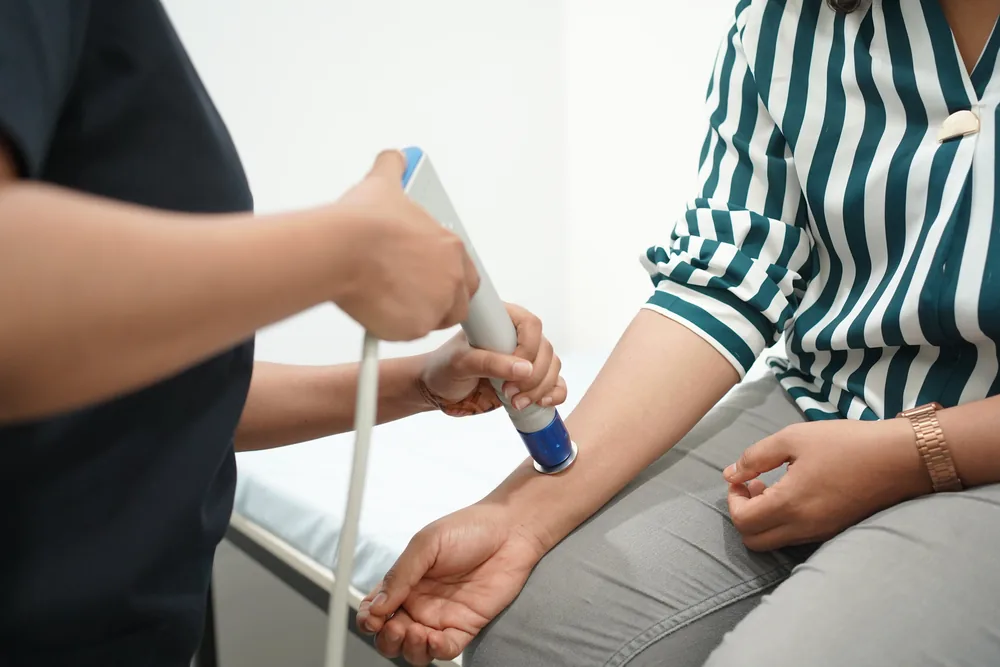
At Maana Spine, we use radial shockwave therapy (ESWT) as part of Maana Spine DTX™ for tight, tender trigger points, mostly in the neck and shoulder muscles. This page sets out what research shows, including where the evidence is strong, where it's weaker, and what we don't yet know.
The short version
- ESWT reduces trigger point pain more than sham (fake) treatment. This is the most consistent finding.
- The strongest evidence is for the trapezius, the large muscle across the top of the shoulders and upper back.
- ESWT hasn't been shown to beat other active treatments, such as dry needling or trigger point injections, in the main meta-analysis.
- Side effects are usually temporary, such as discomfort during treatment and redness or soreness afterwards.
- Research has limits, including different diagnostic methods, treatment settings and follow-up times across studies.
What ESWT is
Shockwave therapy sends pulses of acoustic energy through the skin into the tissue underneath. Radial shockwave, which we use, spreads the energy over an area near the surface.
At Maana Spine, ESWT is used inside the Restore stage of DTX, alongside hands-on muscle release, stretching and exercise. It isn't offered as a stand-alone treatment.
What the studies found
Trapezius meta-analysis (2020). Ten studies, 477 patients with trapezius myofascial pain. ESWT reduced pain significantly more than sham ESWT or ultrasound. Compared with active treatments such as dry needling or trigger point injection, the difference was not significant.
Meta-analysis (Annals of Translational Medicine, 2022). Eight controlled studies, 571 patients. ESWT reduced pain, raised the pressure needed to cause pain, and reduced neck and shoulder disability compared with other methods.
Meta-analysis of five randomised trials (2019). Supported short-term pain reduction with ESWT for trapezius myofascial pain.
Scoping review (2025). Found studies diagnosed trigger points, set up treatment and followed patients up in inconsistent ways, and that there's no fully reliable examination for trigger points.
How we read the evidence
Taken together, ESWT reliably beats sham treatment for neck and upper-back trigger points, so its effect isn't just placebo. But it hasn't been shown to work better than other active treatments. Most benefits were measured over the short term.
That's why we use ESWT as one part of a plan, not on its own. Lasting improvement usually depends on strengthening, movement and changes to daily habits.
Side effects
ESWT is generally well tolerated, but it can have side effects. A 2017 review of ESWT complications (in heel pain studies, not trigger points) found the most common effects were:
- discomfort or pain during treatment
- temporary redness of the skin afterwards
Less often, people had temporary soreness after treatment, swelling, bruising or small red spots on the skin, altered sensation, or headache. Serious complications were rare.
Your physiotherapist adjusts the intensity to keep treatment tolerable and checks whether ESWT is suitable for you before using it.
What we don't know yet
- How long the benefits last beyond the short term
- The ideal number of sessions and settings
- How ESWT compares with other treatments over the long term
- How well findings for the trapezius apply to other muscles
Is ESWT right for you?
Your physiotherapist will decide at your spine assessment whether ESWT suits your condition, as part of your DTX plan. Spine assessments are available at all five Maana Spine clinics in Kochi, Kozhikode, Thiruvananthapuram, Aluva and Perinthalmanna. The consultation fee is ₹250, and no doctor's referral is needed.
Book a Spine Assessment · or call or WhatsApp +91 99950 09403
References
- Trapezius myofascial pain syndrome meta-analysis, 2020. sciencedirect.com
- Wu et al. Annals of Translational Medicine, 2022. atm.amegroups.org
- Meta-analysis of randomised trials of ESWT for trapezius myofascial pain syndrome, 2019. doi.org/10.1097/MD.0000000000019085
- Scoping review of ESWT for myofascial trigger points, 2025. pmc.ncbi.nlm.nih.gov/articles/PMC12565389
- Systematic review of ESWT complications in plantar fasciitis. International Journal of Surgery, 2017;46:133–145. pubmed.ncbi.nlm.nih.gov/28890412