
Written by Ansu Susan Kuriakose, BPT · Clinically reviewed by Jasmal K, BPT, MPT · Last reviewed 5 October 2026
Facet joint pain: back pain from the small joints of the spine
Each vertebra in your spine is linked to the next by a pair of small joints at the back, called facet joints. Like other joints, they can become stiff, irritated or worn with age, and cause back or neck pain. Facet joint pain is common, and most people are treated without surgery.
Book a Spine Assessment · or call or WhatsApp +91 99950 09403

What is facet joint pain?
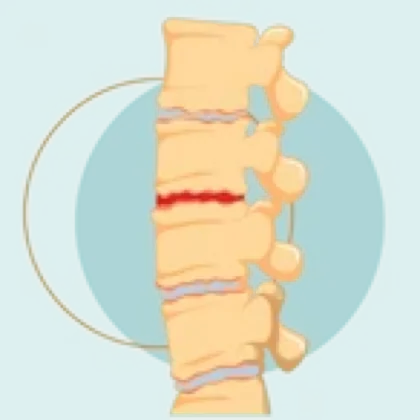
Facet joints guide and limit how your spine bends and twists. When they're irritated or affected by age-related wear (osteoarthritis), they can cause pain. You may see it called facet syndrome, facet arthropathy or facet joint arthritis on a report.
Facet joint pain is estimated to account for about 27% to 40% of lower back pain (approximate; estimates vary). It can also affect the neck.
Facet changes often occur alongside disc changes, as part of lumbar spondylosis or cervical spondylosis.
Symptoms
- aching in the lower back (or neck), often on one or both sides of the spine
- pain that's worse when leaning backwards, twisting or standing for long periods
- stiffness, especially in the morning or after rest
- pain that may spread into the buttock or upper thigh, usually not below the knee
- tenderness over the joints
These symptoms overlap with other causes of back pain, which is why assessment matters.
When back pain is an emergency
How it's diagnosed
There's no simple test for facet joint pain. Research shows that examination findings and scans don't reliably confirm it, because facet changes are common on scans in people without pain and symptoms overlap with other causes.
At your Maana Spine assessment, your physiotherapist looks at your pattern of symptoms, how your back moves, which movements bring on your pain, and any MRI, X-ray or lab reports you bring, to work out what's most likely driving your pain and what will help.
You'll get a physiotherapy diagnosis and a personalised plan. You don't need a scan to book; if one would help, your physiotherapist will recommend an MRI or X-ray.
How we treat facet joint pain at Maana Spine
Treatment follows Maana Spine DTX™, our personalised, non-surgical Precision Spine Care program:
 Assess: we look at the pattern of your pain and rule out red flags.
 Decompress: where it suits your condition, computer-controlled spinal decompression using US FDA 510(k)-cleared technology. If decompression isn't suitable, we use other therapies, such as pulsed signal therapy (PST).
 Restore: mobility work and physiotherapist-led stretching to ease stiffness and restore movement.
 Strengthen: our four-level exercise roadmap (Level 1 Restore, Level 2 Stabilise, Level 3 Strengthen, Level 4 Maintain) to build the muscles that support and control your spine.
 Empower: how to stand, sit, lift and move in ways that ease the load on your facet joints, with written and app-based home exercise programmes.
 Maintain: in-person follow-up at 1, 3, 6 and 12 months. The 1- and 3-month follow-ups are included in your program fee; the 6- and 12-month reviews are charged separately.
A DTX program is typically 15 to 25 sessions of 60 to 75 minutes each. Your physiotherapist will tell you after your assessment how many you're likely to need.
What the research says
Diagnosis is difficult. A 2024 review found no clear link between examination findings, scan results and symptoms in facet joint pain, which makes it hard to diagnose and treat precisely.
Non-surgical care first. When non-surgical care doesn't help, doctors may offer injections or a procedure called radiofrequency treatment to block pain signals from the joint. The same review found that current research doesn't support surgery for facet joint pain.
What the research covers. Another review noted that no trials had studied non-surgical treatments in people with confirmed facet joint pain. In practice, treatment draws on wider evidence for chronic back pain, where a 2021 Cochrane review found that exercise probably reduces pain by an amount that makes a real difference to patients.
PST (pulsed signal therapy). PST is a type of pulsed electromagnetic field (PEMF) therapy. A 2022 review found PEMF reduced long-lasting low back pain more than placebo or other treatments alone, though it didn't improve physical function. These studies used a range of devices, not necessarily PST, and didn't focus on facet joint pain.
Will I need surgery?
Surgery isn't usually recommended for facet joint pain alone. If non-surgical care doesn't help, we'll tell you honestly about other options, such as seeing a pain specialist.
Practical tips
- Keep moving. Gentle activity usually helps more than rest.
- Limit long periods of standing or arching backwards if they bring on your pain.
- Break up sitting and standing with short walks or position changes.
- Build strength gradually with your home programme.
These are general tips, not a substitute for an assessment.
When to book a spine assessment
Book an assessment if back or neck pain has lasted more than a few weeks, keeps coming back, or limits your daily life. Spine assessments are available at all five Maana Spine clinics in Kochi, Kozhikode, Thiruvananthapuram, Aluva and Perinthalmanna. The consultation fee is ₹250, and no doctor's referral is needed.
Book a Spine Assessment · or call or WhatsApp +91 99950 09403
Frequently asked questions
What does facet joint pain feel like?
Usually an ache on one or both sides of the spine that's worse when leaning back, twisting or standing for a long time, and may spread into the buttock or upper thigh.
Can facet joint pain be seen on an MRI?
An MRI can show facet joint changes, but these are common in people without pain too, so a scan alone doesn't confirm the joints are causing your symptoms.
Is facet joint pain the same as arthritis?
It's often linked to wear-and-tear (osteoarthritis) in the facet joints, though facet joints can also be irritated without much visible wear.
Does facet joint pain need surgery?
Rarely. Current research doesn't support surgery for facet joint pain. Non-surgical care comes first; if it doesn't help, injections or radiofrequency treatment by a pain specialist are options.
What exercises help facet joint pain?
Mobility and strengthening exercises for the back and core help many people. Your physiotherapist will choose exercises that don't aggravate your joints and progress them over time.
How many sessions will I need?
A Maana Spine DTX™ program is typically 15 to 25 sessions of 60 to 75 minutes each.
References
- Van Oosterwyck W, Vander Cruyssen P, Castille F, Van de Kelft E, Decaigny V. Lumbar facet joint disease: what, why, and when? Life, 2024;14(11):1480. doi.org/10.3390/life14111480
- Lumbar facet joint interventions review. pmc.ncbi.nlm.nih.gov/articles/PMC4865722
- Hayden JA, Ellis J, Ogilvie R, Malmivaara A, van Tulder MW. Exercise therapy for chronic low back pain. Cochrane Database of Systematic Reviews, 2021. doi.org/10.1002/14651858.CD009790.pub2
- Sun X, Huang L, Wang L, et al. Clinical Rehabilitation, 2022;36(5):636–649. pubmed.ncbi.nlm.nih.gov/35077249