
Written by Ansu Susan Kuriakose, BPT · Clinically reviewed by Jasmal K, BPT, MPT · Last reviewed 5 October 2026
Sacroiliac (SI) joint pain: low back and buttock pain from the pelvis
The sacroiliac (SI) joints connect the base of your spine to your pelvis, one on each side. Pain from these joints is usually felt low in the back, near the dimples above the buttocks, and sometimes in the buttock or thigh. It's a common source of lower back pain, and it's usually treated without surgery.
Book a Spine Assessment · or call or WhatsApp +91 99950 09403
What is SI joint pain?
The SI joints are strong, stable joints that move only a little. They transfer weight between your upper body and legs. Pain can come from the joint itself or the strong ligaments around it. You may see it called SI joint dysfunction, or sacroiliitis when the joint is inflamed.
Possible causes include:
- falls or other injuries
- changes during pregnancy and after childbirth
- wear in the joint with age
- differences in how you walk or load your legs
- inflammatory conditions such as ankylosing spondylitis
Symptoms
- pain low in the back on one side, near the dimple above the buttock
- pain in the buttock, sometimes spreading into the back of the thigh
- pain that's worse when standing on one leg, climbing stairs, getting out of a car, or turning in bed
- stiffness after sitting
Because these symptoms overlap with disc, facet and hip problems, careful assessment is important.
When back pain is an emergency
See a doctor if you have long-lasting back and buttock pain with morning stiffness that improves with activity, especially if it started before age 45. This can be a sign of an inflammatory condition.
How it's diagnosed
Diagnosing SI joint pain is tricky. A 2021 review found that groups of physical tests for the SI joint are much better at ruling it out as the source of pain than at confirming it, and the certainty of that evidence was very low. Scans don't reliably show SI joint pain either.
So your physiotherapist combines your symptoms, a set of SI joint tests, and checks of your lower back and hips to work out what's most likely driving your pain. Any MRI, X-ray or lab reports you bring are reviewed.
You'll get a physiotherapy diagnosis and a personalised plan. You don't need a scan to book; if one would help, your physiotherapist will recommend an MRI or X-ray.
How we treat SI joint pain at Maana Spine
Treatment follows Maana Spine DTX™, our personalised, non-surgical Precision Spine Care program:
 Assess: we work out whether your pain is coming from the SI joint, your lower back or your hip, and rule out red flags.
 Decompress: used where it suits your condition, for example if a disc problem in the lower back is also involved. If decompression isn't suitable, we use other therapies, such as pulsed signal therapy (PST).
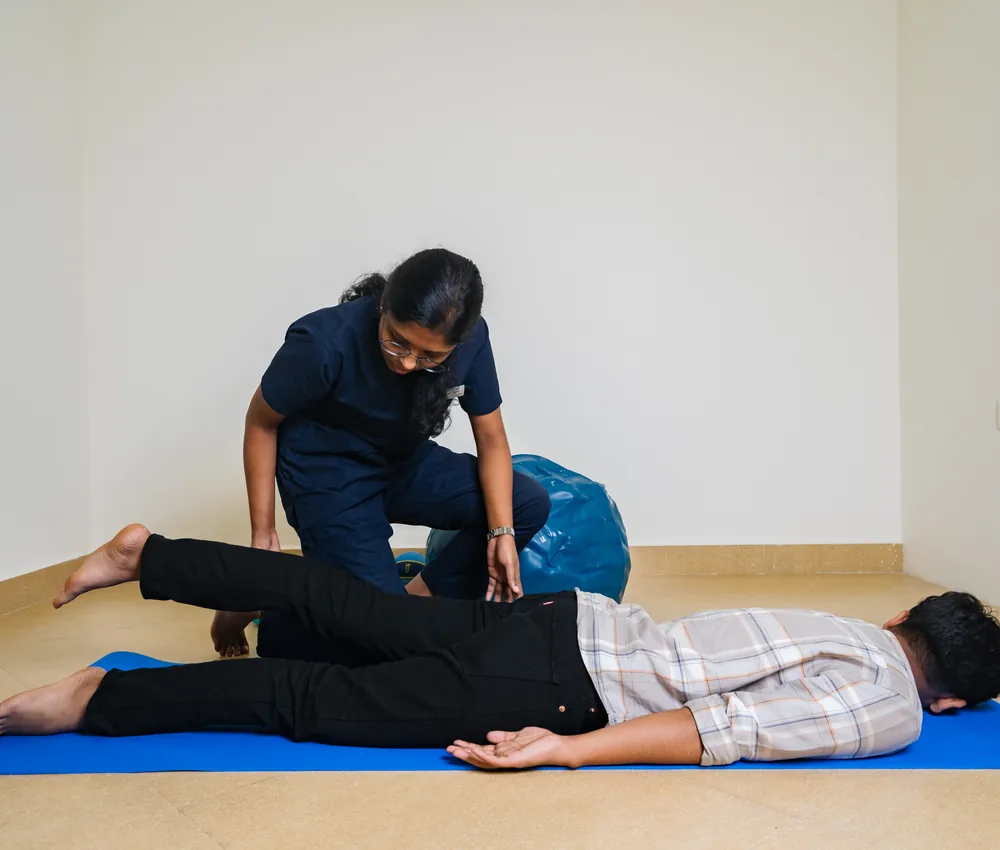
 Restore: mobility work, hands-on treatment and physiotherapist-led stretching for the lower back, pelvis and hips.
 Strengthen: our four-level exercise roadmap (Level 1 Restore, Level 2 Stabilise, Level 3 Strengthen, Level 4 Maintain), focusing on the deep core, buttock and hip muscles that stabilise the pelvis.
 Empower: how to stand, climb stairs, sit and turn in bed in ways that ease the load on the joint, with written and app-based home exercise programmes.
 Maintain: in-person follow-up at 1, 3, 6 and 12 months. The 1- and 3-month follow-ups are included in your program fee; the 6- and 12-month reviews are charged separately.
A DTX program is typically 15 to 25 sessions of 60 to 75 minutes each. Your physiotherapist will tell you after your assessment how many you're likely to need.
What the research says
Diagnosis. As above, physical tests are better at ruling out the SI joint than confirming it, with very low certainty of evidence.
Treatment. A 2022 review in American Family Physician describes SI joint dysfunction as a common cause of lower back pain and recommends starting with a multi-part conservative programme that includes physical therapy exercise. Injections or other procedures by a doctor are options if this doesn't help.
Exercise. For long-lasting low back pain in general, a 2021 Cochrane review found moderate-certainty evidence that exercise probably reduces pain by an amount that makes a real difference to patients.
Practical tips
- Keep active, within comfort.
- Avoid standing on one leg for long, and step up stairs one at a time if they're painful.
- Sleep with a pillow between your knees if lying on your side is uncomfortable.
- Build strength gradually with your home programme.
These are general tips, not a substitute for an assessment.
When to book a spine assessment
Book an assessment if pain low in your back or buttock has lasted more than a few weeks, keeps coming back, or limits your daily life. Spine assessments are available at all five Maana Spine clinics in Kochi, Kozhikode, Thiruvananthapuram, Aluva and Perinthalmanna. The consultation fee is ₹250, and no doctor's referral is needed.
Book a Spine Assessment · or call or WhatsApp +91 99950 09403
Frequently asked questions
Where is SI joint pain felt?
Usually low in the back on one side, near the dimple above the buttock, sometimes spreading into the buttock or back of the thigh.
Can SI joint pain cause sciatica-like pain?
It can cause pain in the buttock and back of the thigh that feels similar to sciatica, though it usually doesn't cause the numbness or weakness of a pinched nerve.
→ Read about sciatica
Is SI joint pain common after pregnancy?
Changes in the pelvis during pregnancy and after childbirth are one possible cause.
→ Pregnancy and postpartum back pain
How is SI joint pain diagnosed?
By combining your symptoms with physical tests of the SI joint, lower back and hips. These tests are better at ruling out the SI joint than confirming it, so assessment looks at the whole picture.
What exercises help SI joint pain?
Exercises that strengthen the deep core, buttock and hip muscles help many people. Your physiotherapist will tailor them to you.
How many sessions will I need?
A Maana Spine DTX™ program is typically 15 to 25 sessions of 60 to 75 minutes each.
References
- Saueressig T, et al. Diagnostic accuracy of clusters of pain provocation tests for detecting sacroiliac joint pain: systematic review with meta-analysis. Journal of Orthopaedic & Sports Physical Therapy, 2021;51(9):422–431. doi.org/10.2519/jospt.2021.10469
- Sacroiliac joint dysfunction: diagnosis and treatment. American Family Physician, 2022;105(3):239. aafp.org
- Hayden JA, Ellis J, Ogilvie R, Malmivaara A, van Tulder MW. Exercise therapy for chronic low back pain. Cochrane Database of Systematic Reviews, 2021. doi.org/10.1002/14651858.CD009790.pub2