
Written by Ansu Susan Kuriakose, BPT · Clinically reviewed by Jasmal K, BPT, MPT · Last reviewed 5 October 2026
Lumbar spondylosis: lower back pain from age-related changes, and how it's treated
Lumbar spondylosis is a common diagnosis on X-ray and MRI reports, especially after age 40. It describes age-related changes in the lower spine. These changes are a normal part of getting older, and many people who have them feel no pain. When they do cause pain and stiffness, a structured, non-surgical program can help you move more easily and get back to your daily life.
Book a Spine Assessment · or call or WhatsApp +91 99950 09403
What is lumbar spondylosis?
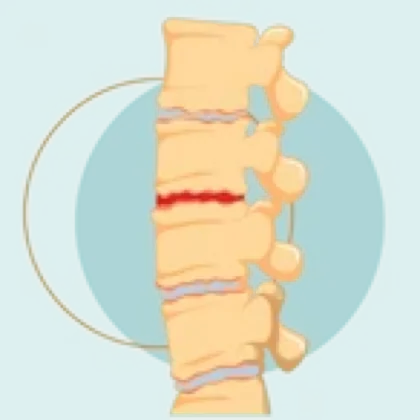
"Spondylosis" means age-related wear in the spine. "Lumbar" refers to the lower back. Lumbar spondylosis can include:
- disc changes: discs losing water and height (degenerative disc disease), sometimes with a disc bulge
- facet joint changes: wear in the small joints at the back of the spine that guide its movement
- bone spurs (osteophytes): small bony growths that form at the edges of the vertebrae
Sometimes these changes narrow the space for the nerves, which is called lumbar spinal stenosis.
Spondylosis can also affect the neck, where it's called cervical spondylosis.
How common is it?
Very common. A large 2015 review of scans in people with no back pain found disc degeneration in about 37% of 20-year-olds, rising to about 96% of 80-year-olds. The authors concluded that many of these changes are part of normal ageing.
That's why a spondylosis report on its own doesn't explain your pain. Your assessment looks at how your back moves and how you feel, not just the scan.
Symptoms
Many people with lumbar spondylosis have no symptoms. When it does cause problems, you may notice:
- aching or stiffness in your lower back, often worse in the morning or after rest
- pain after standing or sitting for a long time
- reduced flexibility, such as difficulty bending
- pain spreading into your buttocks or legs, with numbness or tingling, if a nerve is irritated
- leg pain or heaviness when walking that eases when you sit or bend forward (a sign of spinal stenosis)
What causes it?
- Age: gradual changes in the discs and joints of the spine
- Physical load: years of heavy lifting, bending or long hours of sitting
- Other factors that may contribute, such as previous back injury, excess body weight, smoking and genetics
When back pain is an emergency
How it's diagnosed
At your Maana Spine assessment, your physiotherapist asks about your symptoms and daily life, checks how your lower back moves, tests the strength, sensation and reflexes in your legs, and reviews any MRI, X-ray or lab reports you bring. You'll get a physiotherapy diagnosis and a personalised plan.
You don't need a scan to book. If one would help, your physiotherapist will recommend an MRI or X-ray.
How we treat lumbar spondylosis at Maana Spine
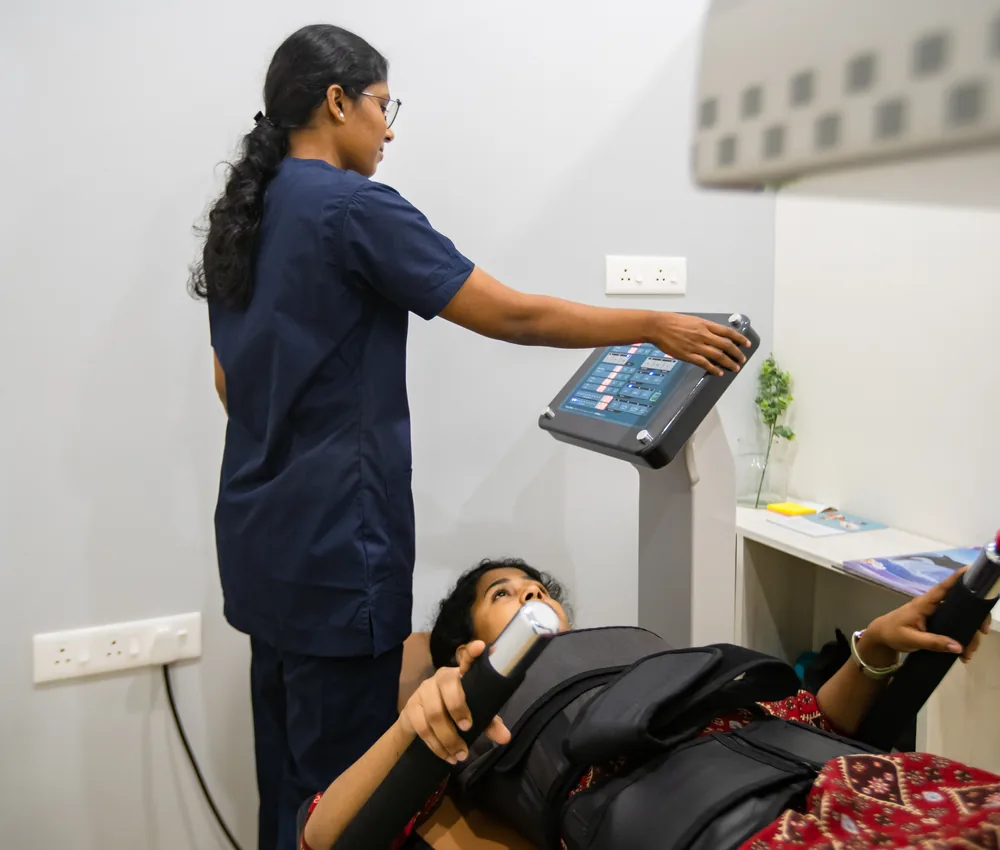
Treatment follows Maana Spine DTX™, our personalised, non-surgical Precision Spine Care program:
 Assess: we identify which structures are driving your pain (discs, joints, nerves or muscles) and rule out red flags.
 Decompress: where it suits your condition, computer-controlled spinal decompression using US FDA 510(k)-cleared technology. If decompression isn't suitable, we use other therapies, such as pulsed signal therapy (PST).
 Restore: gentle mobility work and physiotherapist-led stretching to ease stiffness and improve movement.
 Strengthen: our four-level exercise roadmap (Level 1 Restore, Level 2 Stabilise, Level 3 Strengthen, Level 4 Maintain) to build the muscles that support your spine.
 Empower: how to sit, stand, lift and sleep comfortably, with written and app-based home exercise programmes.
 Maintain: in-person follow-up at 1, 3, 6 and 12 months. The 1- and 3-month follow-ups are included in your program fee; the 6- and 12-month reviews are charged separately.
A DTX program is typically 15 to 25 sessions of 60 to 75 minutes each, usually with the same physiotherapist throughout.
What the research says
Exercise. A 2021 Cochrane review found moderate-certainty evidence that exercise probably reduces pain in long-lasting low back pain, by an amount that makes a real difference to patients.
Decompression and traction. A 2013 trial of 148 people with age-related lower back disease found that traction-decompression in three planes gave faster and longer-lasting relief over 12 to 15 weeks than single-plane traction or no traction. The trial had limitations, including short follow-up and no description of blinding. Overall, in the small trials so far, pain relief has been similar between decompression and traditional traction, with some trials finding added benefits from decompression for function and patient satisfaction. Either works better combined with structured physiotherapy than physiotherapy alone.
PST (pulsed signal therapy). PST is a type of pulsed electromagnetic field (PEMF) therapy. A 2022 review found PEMF reduced long-lasting low back pain more than placebo or other treatments alone, though it didn't improve physical function. These studies used a range of PEMF devices, not necessarily PST.
Will I need surgery?
Most people with lumbar spondylosis don't need surgery. Non-surgical care is a reasonable first step for most people, and surgery stays available if you need it. If spondylosis has narrowed the space for your nerves and your symptoms are severe or getting worse, we'll tell you honestly if you should see a surgeon.
Living with lumbar spondylosis: practical tips
- Start the day gently. A few easy movements before getting up can ease morning stiffness.
- Stay active. Walking and the exercises from your programme help keep your spine moving.
- Vary your position. Avoid long stretches of sitting or standing.
- Lift with care. Keep loads close to your body and avoid twisting.
These are general tips, not a substitute for an assessment.
When to book a spine assessment
Book an assessment if lower back pain or stiffness has lasted more than a few weeks, keeps coming back, spreads into your legs, or limits your work or daily life. Spine assessments are available at all five Maana Spine clinics in Kochi, Kozhikode, Thiruvananthapuram, Aluva and Perinthalmanna. The consultation fee is ₹250, and no doctor's referral is needed.
Book a Spine Assessment · or call or WhatsApp +91 99950 09403
Frequently asked questions
Is lumbar spondylosis serious?
Usually not. It describes age-related changes that are very common, including in people with no pain. It needs urgent attention only if it comes with warning signs such as numbness around your genitals or bottom, bladder or bowel changes, or worsening leg weakness.
Is spondylosis the same as arthritis of the spine?
They overlap. Spondylosis includes wear-and-tear (osteoarthritis-type) changes in the facet joints, along with disc changes and bone spurs.
Can lumbar spondylosis be reversed?
The age-related changes themselves don't reverse, but pain and stiffness often improve a great deal with the right exercise and care.
What exercises are good for lumbar spondylosis?
Mobility exercises, core strengthening and regular walking help many people. Your physiotherapist will choose exercises that suit your symptoms and progress them through our four-level roadmap.
Can spinal decompression help lumbar spondylosis?
It may help some people, and it's used where it suits your condition. At Maana Spine, decompression is always combined with exercise-based rehabilitation.
What's the difference between spondylosis and spondylolisthesis?
Spondylosis is general age-related wear in the spine. Spondylolisthesis is when one vertebra slips forward over the one below.
References
- Brinjikji W, et al. Systematic literature review of imaging features of spinal degeneration in asymptomatic populations. American Journal of Neuroradiology, 2015;36(4):811–816. doi.org/10.3174/ajnr.A4173
- Hayden JA, Ellis J, Ogilvie R, Malmivaara A, van Tulder MW. Exercise therapy for chronic low back pain. Cochrane Database of Systematic Reviews, 2021. doi.org/10.1002/14651858.CD009790.pub2
- Zhirnov VA, Krest'yanov DP, Vasil'kin AK. Traumatology and Orthopedics of Russia, 2013. doi.org/10.21823/2311-2905-2013--1-51-60
- Park SH, Kim CS, Lee DG, Ahn SH. Journal of the Korean Society of Physical Therapy, 2011;23(5):29–34. Read the study
- Sun X, Huang L, Wang L, et al. Efficacy of pulsed electromagnetic field on pain and physical function in patients with low back pain: a systematic review and meta-analysis. Clinical Rehabilitation, 2022;36(5):636–649. pubmed.ncbi.nlm.nih.gov/35077249